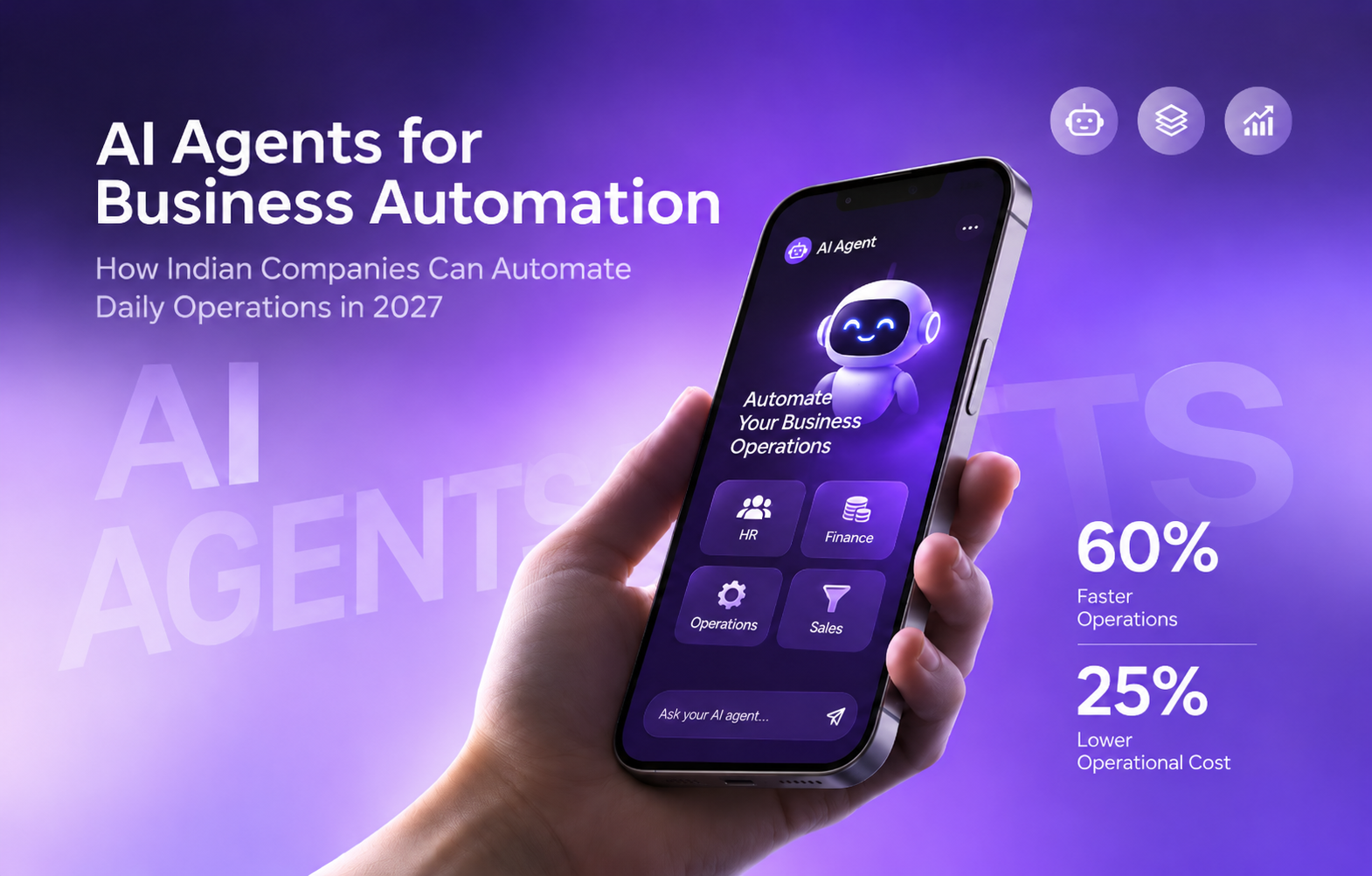
A sales enquiry arrives on your website after office hours. Nobody sees it until the next morning, and the customer may already have contacted a competitor. Elsewhere, employees are chasing approvals, checking order updates and copying invoice details between systems. These tasks are routine, but they consume valuable time because information must be noticed, checked and passed along.
This is where AI agents for business automation are attracting attention. Unlike basic automation tools, AI agents can understand a goal, gather information, interact with connected software and complete approved steps. They can help businesses qualify enquiries, prepare customer support responses, organise documents and manage repetitive workflows.
However, AI agents should not be given unlimited authority to make business decisions. They need reliable information, clearly defined permissions and human oversight.
For Indian companies planning their operations in 2027, the practical question is simple: which repetitive workflow is slowing your team down, and could an AI agent make it easier?
What Exactly Is an AI Agent?
A traditional automation system follows fixed instructions. For example, it may send an email whenever someone submits a website form. A chatbot mainly responds to questions based on its available information. An AI agent goes a step further. It can understand a defined goal, determine the steps required, use connected tools and adjust its next action based on the information it receives.
Consider a customer asking whether an order will arrive before Friday. A chatbot might provide a tracking link. An AI agent connected to the order management system and courier information could locate the order, check the estimated delivery date and prepare a response. If important details are missing, it can transfer the request to an employee.
This does not mean an AI agent is always correct. Its performance depends on the quality of its data, connected tools, instructions and access permissions.
Why Are AI Agents Gaining Attention in India?
Indian businesses are increasingly exploring artificial intelligence to improve productivity, customer service and internal operations. AI adoption is no longer limited to large technology companies. Organisations across different industries are evaluating how AI can support everyday business activities.
Deloitte’s 2026 State of AI research found that 40% of Indian respondents reported significant or full AI use. ServiceNow’s 2026 research reported that 54% of Indian organisations were deploying AI agents, while only 11% had moved to autonomous workflows. The research also found that 22% had AI testing, auditing and risk-assessment processes in place.
These are survey findings rather than measurements of every Indian business. However, they highlight an important point: adopting AI tools is only one part of the process. Businesses also need reliable data, connected systems and clear rules about when employees should take control.
For small and medium-sized businesses, starting with one well-defined automation project may be more practical than investing in a large AI programme immediately.
5 Everyday Business Tasks AI Agents Can Help Automate
The most useful applications of AI agents are often repetitive tasks with predictable steps and clear outcomes. Here are five areas where businesses can explore AI-powered workflow automation.
1. Sorting and Qualifying Sales Enquiries
Businesses receive enquiries through websites, social media, email and advertising campaigns. Sales teams must review these enquiries, understand customer requirements and decide who should handle each request.
An AI sales agent can review incoming enquiries, ask relevant follow-up questions, classify the requirements and create a record in the CRM system. For example, a software development company could identify whether an enquiry is related to ERP software, mobile applications or website development and route it to the appropriate salesperson.
This can reduce the time spent on manual lead sorting and help sales teams respond more efficiently. However, pricing, delivery commitments and important sales decisions should come from approved information or a qualified employee.
2. Answering Common Customer Questions
Customer support teams often spend considerable time answering similar questions about services, orders, appointments and account information. AI agents can help manage some of these repetitive interactions.
When connected to approved help articles and customer records, an agent can answer routine questions, collect missing details and create support tickets. It can also summarise the conversation for the employee who handles the request later.
This is particularly useful for businesses receiving enquiries outside regular working hours. A clear handover process is still essential when a customer has an unusual, urgent or complicated issue.
3. Preparing Documents and Approval Requests
Many companies still depend on employees to collect information from invoices, purchase requests and other business documents. Missing details can delay approvals and create additional administrative work.
An AI agent can extract information from a document, check whether required fields are missing and prepare an approval request. Once an authorised employee approves it, the agent may update the relevant business system.
Actions involving payments, contract acceptance and vendor bank-detail changes should remain subject to appropriate human approval. Automation should make administrative work easier without removing necessary business controls.
4. Coordinating Appointments and Reminders
Scheduling appointments involves checking availability, communicating with customers, confirming bookings and sending reminders. These activities can become time-consuming when handled manually.
An AI agent connected to a calendar can suggest available time slots, record confirmed appointments and send reminders. If a request falls outside the company's booking rules, it can transfer the matter to an employee.
There is also a difference between suggesting an available appointment slot and cancelling a paid booking. Businesses should define which scheduling actions an agent can perform independently and which require approval.
5. Helping Employees Find Company Information
Employees regularly search for internal documents, company policies, product information and operational procedures. When information is spread across different folders and platforms, finding the correct document can take longer than expected.
An internal AI agent can search approved company documents and direct employees to the relevant policy, form or information. This can make internal knowledge easier to access.
However, the system must use updated documents and appropriate access controls. Employees should only be able to retrieve information they are authorised to view.
How Connected Business Software Makes AI Automation More Useful
An AI agent becomes more useful when it can work with the systems where business information is stored. These may include CRM, ERP, helpdesk, calendar, inventory and accounting software.
For example, when a new sales enquiry arrives, an agent may be able to:
- Check whether the customer already exists in the CRM.
- Retrieve relevant customer information.
- Create a new lead record when required.
- Assign the enquiry to the appropriate salesperson.
- Create a follow-up task for the sales team.
These activities can reduce manual data entry and help information move between departments. However, if the connected systems contain duplicated or outdated records, automation can spread those errors faster.
Businesses should therefore review their existing data and processes before investing in AI automation.
A well-planned CRM system helps organise customer information and sales activities. Custom software development can support workflows that require specific business integrations, while mobile app development may be relevant when customer-facing applications are part of the process.
Adding AI to every business activity is not a strategy. The priority should be solving a genuine operational problem.
Ready-Made AI Tools or Custom AI Agent Development: Which Is Better?
Businesses exploring AI automation generally have two options: use an existing AI-powered product or develop a custom solution around their own processes.
When Ready-Made AI Tools Make Sense
Ready-made products may be suitable for common activities such as meeting summaries, basic customer questions and standard administrative tasks. They can help businesses experiment with AI without developing an entirely new system.
However, their capabilities may be limited when a business needs specific approval rules, internal database access or integrations with several existing applications.
When Custom AI Agent Development Is Worth Considering
Custom development becomes more relevant when an agent needs to follow unique business rules, access internal systems or coordinate several connected workflows.
For example, a distributor may need an agent to check stock availability across multiple branches, review customer-specific terms and prepare an order for approval. A standard tool may not support every step required by that business.
Before choosing a solution, ask vendors to demonstrate realistic business scenarios. Review system access, data storage, error handling, activity logs and the process employees can follow when they need to take over. Do not select a solution based only on an impressive demonstration.
Risks Businesses Should Consider Before Implementing AI Agents
AI agents can make mistakes. They may misunderstand a request, use outdated information or follow misleading instructions included in a document. If an agent has broad access to business systems, a small error can create a much larger problem.
Gartner’s 2026 guidance highlights the importance of tracking AI agents, defining their permissions, governing the information they can access and monitoring their behaviour.
Businesses should establish the following controls before deploying AI agents:
- Limit system access: Give each agent access only to the information and tools required for its assigned task.
- Keep human approval: Require authorised employees to approve payments, refunds, contract changes and other high-impact actions.
- Maintain activity records: Keep records of the information accessed and actions performed by the agent.
- Test different situations: Check how the agent handles incomplete requests, unusual cases and unexpected failures.
- Provide a human handover: Allow employees to take over when the agent is uncertain or a customer requests human assistance.
- Review permissions regularly: Reassess access and performance whenever the workflow or connected system changes.
Businesses should also check how an AI provider handles, retains and protects personal or confidential information. Indian companies need to assess applicable data-protection obligations and seek qualified advice where necessary.
How to Start Implementing AI Agents in Your Business in 2027
Implementing AI automation does not have to begin with a large project. A focused pilot can help a business understand the technology, identify practical limitations and measure whether the solution is useful.
Employees should also be involved in the planning process. They understand which customer questions occur repeatedly, where approvals get delayed and what information is needed at each stage. Their feedback can help identify exceptions that might otherwise be missed.
Step 1: Identify One Repetitive Business Task
Choose a frequent task with repeated steps and a measurable outcome. Instead of setting a broad goal such as improving customer service, identify a specific activity such as classifying website enquiries and creating CRM follow-up tasks.
Step 2: Understand the Existing Workflow
Map how the process currently works. Identify where requests begin, which systems are involved, who makes decisions and where delays occur. Remove unnecessary steps before introducing automation.
Step 3: Define What the AI Agent Can and Cannot Do
Decide which information the agent can access and which actions it can perform. Start with low-risk activities. Keep human approval for payments, legal commitments and decisions that may affect customer rights.
Step 4: Test the Solution Before Expanding
Test the agent using realistic examples, including incomplete requests and unusual situations. Check whether it provides accurate responses, handles errors properly and transfers complex cases to employees. Keep a manual process available during the testing stage.
Step 5: Measure the Results
Track response time, task completion rate, time saved, errors, escalations and employee feedback. If employees are spending more time correcting the agent than completing the original task, review the workflow before expanding the implementation.
The Real Opportunity Is Better Work, Not More AI
AI agents will not automatically fix poor business records, unclear approval processes or disconnected software. Automating a broken process can simply make mistakes happen faster.
The real value of AI agents for business automation is practical. They can help move information between systems, handle routine activities and prepare work for employee approval. People remain essential for business judgement, customer relationships and accountability.
For Indian companies planning their operations in 2027, the best starting point is to identify repetitive work that prevents employees from focusing on more valuable activities. Then decide whether conventional automation, an existing AI product or custom AI agent development is the right solution.
Sometimes, the simplest solution is still the best one.
Frequently Asked Questions About AI Agents for Business Automation
Are AI agents and chatbots the same?
No. A chatbot mainly responds to messages. An AI agent can work towards a defined goal by completing multiple steps and using connected tools. Some chatbots include agent-like features, but the terms are not interchangeable.
Can small businesses in India use AI agents?
Yes. Small businesses can begin with limited tasks such as sorting enquiries, summarising customer support tickets or answering approved frequently asked questions. The solution should match the company's budget, data readiness and existing workflow.
Do AI agents replace employees?
AI agents are better viewed as tools for selected repetitive tasks rather than complete replacements for employees. People are still needed to manage exceptions, build customer relationships, make important decisions and take responsibility for business outcomes.
Is custom AI agent development always necessary?
No. Ready-made AI tools may work well for common tasks. Custom development is more relevant when an agent needs to follow specific business rules, access internal databases or connect multiple existing systems.
How can a company measure whether an AI agent is working?
Compare the process before and after implementation. Measure the time taken to complete tasks, completion rates, response speed, error rates, escalations and employee feedback. Reliability and customer experience should matter alongside cost savings.
Start with One Business Workflow That Needs Attention
Useful AI automation begins with understanding how work moves through your business today. IPIX Technologies helps businesses plan and develop software solutions that connect teams, systems and everyday operations.
If you are exploring AI-powered business automation, start with one process and assess whether workflow automation, system integration or custom software can improve it. The right solution should address a real business requirement rather than introduce technology for its own sake.
Talk to IPIX Technologies to discuss a practical starting point for your business.






























 Talk to our Expert