How AI Agents Are Changing Business Operations in 2026
Posted on : 25 June, 2026
Artificial intelligence has become a familiar part of modern business operations. Over the past few years, organisations have adopted AI tools for content creation, customer support, software development, and information retrieval. However, a new phase of AI adoption is now emerging. Businesses are moving beyond AI assistants that simply respond to prompts and toward AI systems that can perform tasks, manage workflows, and support decision-making with greater autonomy. These systems are commonly referred to as AI agents.
Unlike traditional AI tools that depend entirely on user instructions, AI agents are designed to pursue goals, execute actions, and interact with multiple systems to complete tasks. They represent a significant shift in how businesses think about automation and operational efficiency. As organisations continue searching for ways to improve productivity, reduce manual work, and scale operations more effectively, AI agents are becoming one of the most important technology trends shaping business operations in 2026.
What Are AI Agents?
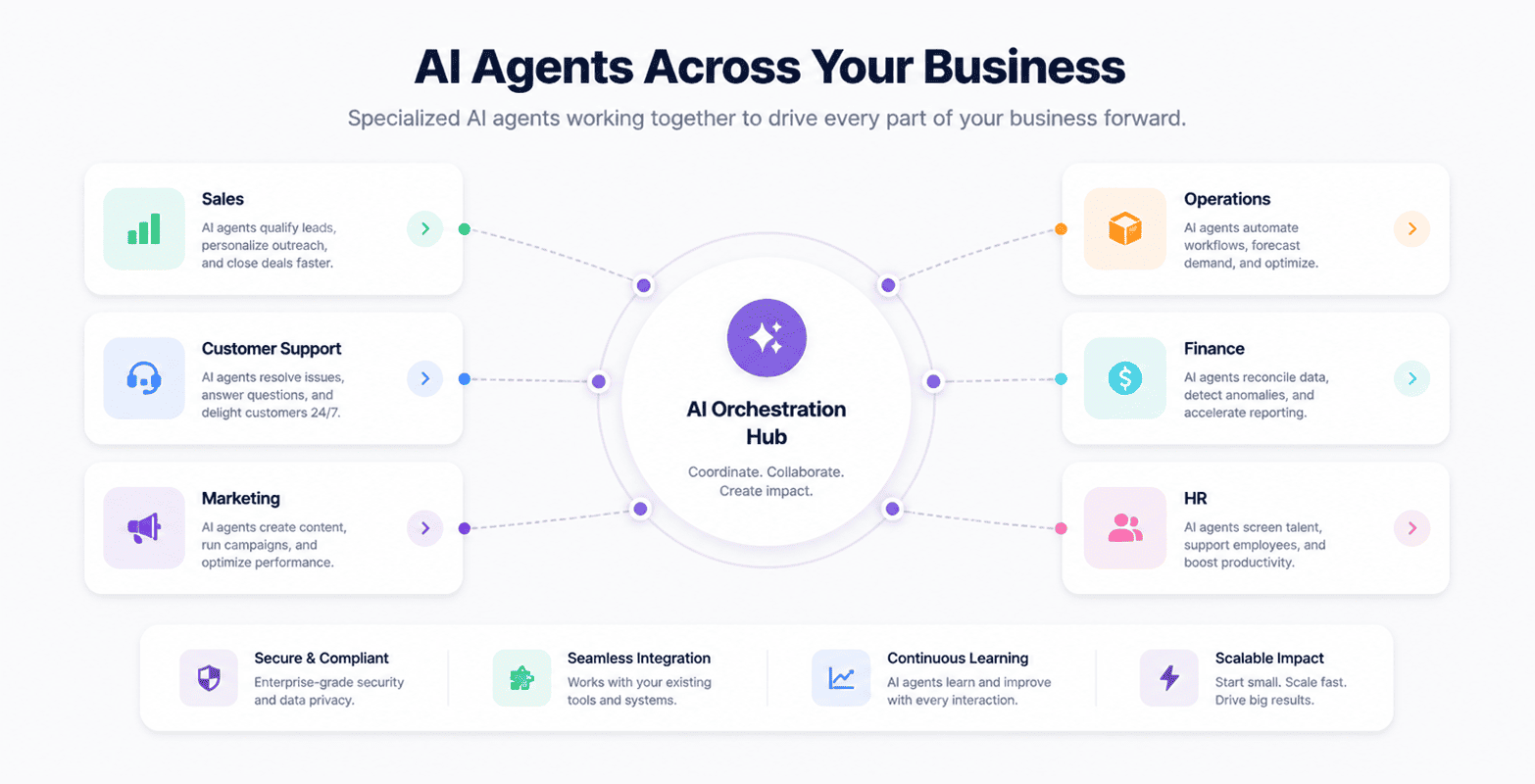
The term "AI agent" is often used broadly, but the concept is relatively straightforward. An AI agent is an artificial intelligence system capable of performing actions on behalf of users or organisations in pursuit of a defined objective. Traditional AI tools generally wait for instructions. A user submits a request, and the system generates a response. AI agents operate differently.
They can:
- analyse information
- make decisions within defined boundaries
- interact with software systems
- execute workflows
- monitor progress toward goals
Instead of responding to a single prompt, an AI agent can often manage a sequence of related tasks. For example, an AI assistant might draft an email when asked.
An AI agent could:
- identify a customer inquiry
- retrieve relevant information
- generate a response
- route the communication
- update internal systems
All within a structured workflow. This shift from information generation to task execution is what makes AI agents particularly significant for businesses.
Why Businesses Are Paying Attention to AI Agents
Several factors are driving increased interest in AI agents. First, operational complexity continues to increase. Businesses manage:
- larger data volumes
- more digital systems
- distributed teams
- increasing customer expectations
At the same time, organisations face pressure to improve productivity without continually increasing operational overhead. Traditional automation addresses some of these challenges but often depends on rigid rules and predefined workflows.
AI agents introduce greater flexibility. Because they can interpret information and adapt to changing circumstances, they are capable of supporting more dynamic operational environments. This allows businesses to automate tasks that previously required human judgement or coordination. As a result, AI agents are increasingly viewed as a bridge between traditional automation and intelligent decision support.
AI Agents in Customer Service Operations
Customer service is one of the most visible areas where AI agents are creating value. Many businesses already use chatbots to answer common questions. However, AI agents extend beyond basic conversational support.
Modern AI agents can:
- analyse customer requests
- retrieve information from knowledge bases
- identify intent
- prioritise issues
- escalate cases when necessary
- generate personalised responses
Rather than simply answering questions, these systems can participate in the service workflow itself. For example, if a customer reports a billing issue, an AI agent may:
- verify account details
- review transaction history
- identify possible causes
- generate recommendations
- route unresolved issues to the correct department
This reduces response times while improving service consistency. Businesses benefit because support teams can focus on complex interactions rather than routine requests.
AI Agents in Sales and CRM Processes
Sales operations involve many repetitive activities that consume significant time. Examples include:
- lead qualification
- prospect research
- follow-up communication
- pipeline updates
- meeting preparation
AI agents are increasingly being used to support these processes. Instead of requiring sales teams to manually review every lead, AI agents can analyse available information and identify prospects that match predefined criteria.
They can also:
- generate outreach suggestions
- summarise customer interactions
- update CRM records
- recommend next actions
This improves efficiency while helping teams focus on relationship-building activities. Businesses seeking to improve pipeline visibility and sales efficiency may also benefit from understanding the principles discussed in Sales Pipeline Management 101: How CRM Automation Helps Close More Deals, where automation plays a critical role in maintaining process consistency. AI agents expand this concept by adding reasoning and decision-support capabilities to existing workflows.
AI Agents and Workflow Automation
Workflow automation has traditionally relied on predefined rules. For example:
- if a form is submitted, send a notification
- if inventory reaches a threshold, create a purchase request
- if a payment is received, update financial records
These processes remain valuable, but they are limited when situations require interpretation or contextual decision-making. AI agents introduce a more intelligent layer to automation. Instead of simply executing predefined actions, they can:
- analyse information
- determine priorities
- identify exceptions
- recommend actions
This makes them particularly effective in environments where workflows vary from case to case. For businesses focused on operational efficiency, AI agents represent a natural extension of the concepts explored in How Workflow Automation Reduces Operational Errors. Automation handles repetition. AI agents handle complexity. Together, they create more adaptive operational systems.
AI Agents in Business Research and Knowledge Management
Many organisations spend significant time searching for information. Employees often need to review:
- policies
- reports
- technical documentation
- project records
- customer histories
As information volumes increase, locating the right knowledge becomes more difficult. AI agents are increasingly being deployed as knowledge assistants. These systems can:
- search internal databases
- analyse documentation
- summarise findings
- answer operational questions
This reduces the time employees spend navigating multiple information sources. Knowledge-intensive organisations such as consulting firms, technology companies, legal environments, and research teams are particularly interested in this capability. The value lies not only in faster information retrieval but also in improved decision support.
AI Agents and Enterprise Decision-Making
Business decisions depend on timely and accurate information. Managers often review multiple reports, performance indicators, and operational updates before taking action. AI agents can support this process by:
- consolidating information
- identifying trends
- highlighting anomalies
- generating summaries
Rather than replacing decision-makers, they help reduce information overload. Leaders gain faster access to relevant insights, allowing them to focus on strategy rather than data collection. This role is expected to expand significantly as AI agents become more integrated into business systems.
AI Agents in Employee Training and Learning
Employee training is another area where AI agents are creating meaningful change. Traditional learning environments often depend on fixed training materials and scheduled support sessions. While these methods remain useful, they do not always adapt effectively to individual learning needs. AI agents introduce a more personalised approach.
They can:
- guide employees through onboarding
- recommend learning resources
- answer training-related questions
- assess knowledge gaps
- provide real-time support
Rather than searching through manuals or waiting for assistance, employees can interact with AI-powered learning assistants that provide immediate guidance. For example, a new employee learning an internal process may ask an AI agent for clarification, request examples, or receive step-by-step instructions based on their role. This creates a more responsive learning experience. The growing role of AI in workplace education is also reflected in How AI Tutors Are Transforming Modern Learning Management Systems, where intelligent support systems are helping organisations improve engagement and knowledge retention. As businesses continue investing in workforce development, AI agents are expected to become increasingly integrated into learning ecosystems.
The Role of Claude and Advanced AI Models
The effectiveness of AI agents depends heavily on the intelligence that powers them. Advanced models such as Claude are increasingly being used as the reasoning engines behind AI-driven business workflows. Unlike basic automation tools, these models can:
- interpret complex information
- analyse large documents
- generate structured responses
- support decision-making processes
This makes them particularly useful in environments where tasks require contextual understanding rather than simple rule execution. For example:
- compliance reviews
- policy interpretation
- research analysis
- contract assessment
- strategic planning support
can all benefit from AI systems capable of deeper reasoning. As explored in What the New Claude AI Means for Businesses, the evolution of advanced AI models is enabling organisations to move beyond simple automation and toward more intelligent operational support. AI agents represent one of the most practical applications of these advancements.
From Single Agents to Multi-Agent Systems
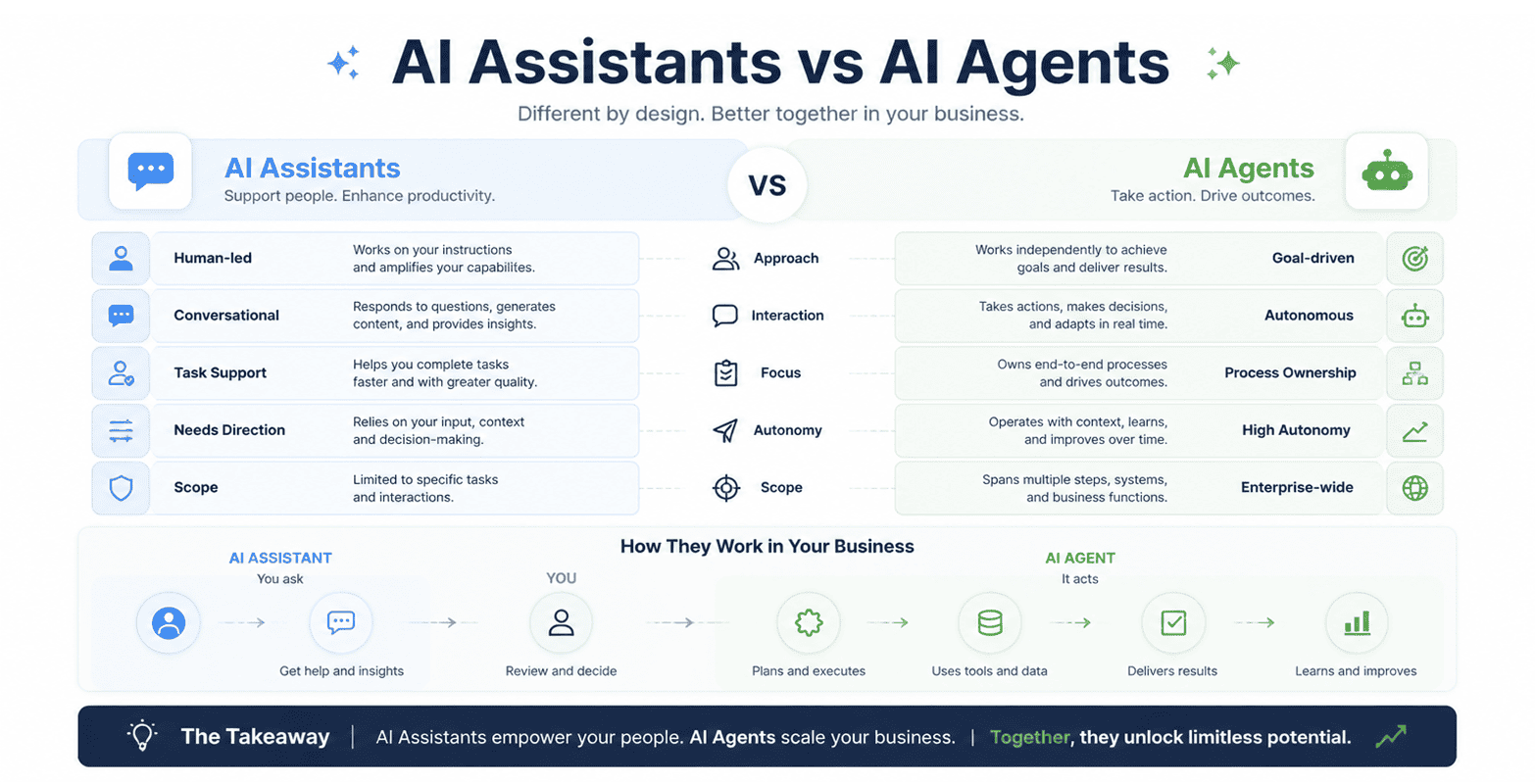
One of the most significant developments expected in 2026 is the rise of multi-agent business environments. Instead of relying on a single AI agent, organisations are beginning to explore systems where multiple specialised agents work together. For example:
A business may deploy:
- a sales agent
- a customer support agent
- a reporting agent
- a procurement agent
- a learning assistant
Each agent focuses on a specific area while collaborating with others when necessary. A customer request might trigger several actions simultaneously:
- customer information retrieval
- account analysis
- support recommendation generation
- follow-up scheduling
These tasks can be coordinated across multiple agents without requiring constant human intervention. This approach has the potential to transform how organisations manage operational workflows.
Why AI Agents Are Different from Traditional Automation
Businesses have used automation for many years. However, traditional automation and AI agents solve different problems. Traditional automation works best when:
- workflows are predictable
- rules remain consistent
- exceptions are limited
Examples include:
- invoice generation
- approval routing
- data synchronisation
AI agents become valuable when situations require interpretation. For example:
- analysing customer intent
- prioritising tasks
- recommending actions
- identifying unusual patterns
This ability to adapt makes AI agents more suitable for complex operational environments. Rather than replacing automation, they extend its capabilities. Businesses are increasingly combining both approaches to create more intelligent systems.
Challenges Businesses Should Consider
Despite the opportunities, AI agents are not without challenges. Successful adoption requires careful planning. Businesses must consider:
Data Quality
AI agents depend on access to reliable information. Poor data quality can lead to inaccurate recommendations and inconsistent results.
Governance
Organisations need clear policies regarding:
- decision authority
- approval processes
- oversight responsibilities
AI agents should operate within defined boundaries.
Security
Many AI workflows involve sensitive information. Businesses must ensure that:
- data protection requirements are met
- access controls remain effective
- compliance standards are maintained
Human Oversight
AI agents are powerful tools, but they should not operate entirely without supervision. Human judgement remains essential for:
- strategic decisions
- policy interpretation
- exception management
Businesses that combine AI capabilities with appropriate governance are more likely to achieve sustainable results.
Preparing for Agentic Business Operations
As AI agents become more capable, businesses should begin evaluating where these technologies can create measurable value. The most successful implementations often start with clearly defined objectives.
Examples include:
- reducing administrative workload
- improving customer response times
- enhancing reporting efficiency
- supporting employee training
- improving knowledge accessibility
Rather than attempting large-scale transformation immediately, many organisations begin with targeted use cases and expand gradually. This approach allows teams to understand operational impacts while maintaining control over implementation. Businesses that adopt AI strategically are generally better positioned to realise long-term benefits.
What the Future Looks Like
The future of business operations will likely involve increasing collaboration between humans and AI systems. Instead of replacing employees, AI agents are expected to support them by handling repetitive, information-intensive, and time-consuming activities.
This allows professionals to focus more on:
- creativity
- relationship building
- problem-solving
- strategic planning
As AI technology continues to advance, the distinction between information retrieval, workflow execution, and decision support will become less pronounced. AI agents will increasingly function as operational partners embedded throughout business processes. Organisations that develop the ability to manage these systems effectively may gain significant advantages in productivity, agility, and scalability.
Conclusion
AI agents represent a major evolution in how businesses approach automation and operational efficiency. Unlike traditional AI assistants that primarily generate information, AI agents can analyse data, execute tasks, support workflows, and contribute to decision-making processes. From customer service and sales operations to employee training and knowledge management, these systems are creating new opportunities for organisations to improve productivity while reducing operational friction. As the technology continues to mature, businesses will increasingly move toward agent-driven workflows that combine automation, intelligence, and human oversight. The organisations that benefit most will be those that align AI adoption with practical business objectives rather than treating it as a standalone technology trend.
At IPIX, an experienced IT company in India, emerging technologies such as AI agents are evaluated through a practical business lens, helping organisations identify solutions that support automation, innovation, and long-term operational growth.




















 Talk to our Expert