How Workflow Automation Reduces Operational Errors

Posted on : 20 May, 2026
Operational efficiency is often discussed in terms of speed and productivity, but one of the most important factors businesses overlook is accuracy. As organisations grow, workflows become more complex. Departments depend on shared information, approvals move across multiple stages, and routine processes involve increasing amounts of data handling. In many businesses, these processes are still managed manually through spreadsheets, email coordination, repetitive data entry, and disconnected systems. While manual methods may appear manageable in smaller environments, they gradually introduce inconsistencies that affect operational reliability.
This is where workflow automation becomes important. Workflow automation is not simply about reducing human involvement. Its primary role is to create structured processes where repetitive operational tasks happen consistently and predictably. By automating routine actions, businesses reduce the likelihood of delays, miscommunication, and human error. As organisations scale, automation becomes less about convenience and more about operational stability.
Understanding Operational Errors in Business Processes
Operational errors are not always dramatic failures. In most cases, they appear as small inconsistencies that accumulate over time.
Examples include:
- incorrect data entry
- delayed approvals
- missed follow-ups
- duplicate records
- inconsistent reporting
- communication gaps between departments
Individually, these issues may seem minor. However, when they occur repeatedly across departments, they create inefficiencies that affect productivity, customer experience, and decision-making. Many operational errors happen not because employees lack capability, but because workflows depend heavily on manual coordination.
For example, when one department updates information manually and another team relies on that update to continue a process, delays or inconsistencies become more likely. The more steps a workflow contains, the greater the chance of variation. Over time, businesses begin spending more effort correcting issues than preventing them.
Why Manual Processes Increase Error Frequency
Manual workflows require constant human intervention.
Employees often need to:
- transfer information between systems
- send approval requests manually
- update spreadsheets
- verify records repeatedly
- track progress through email chains
Each step introduces opportunities for inconsistency.
For example:
- a customer record may be entered differently across departments
- invoices may contain outdated information
- approvals may be delayed because notifications are missed
- inventory updates may not reflect real-time stock levels
These problems become more visible as operational volume increases. A process that works adequately for ten transactions may become unreliable when handling hundreds or thousands. Manual environments also depend heavily on individual memory and attention. When processes rely on employees remembering every step, variation becomes inevitable.
What Workflow Automation Actually Means
Workflow automation refers to the use of software systems to execute predefined operational actions automatically based on rules or triggers. Instead of requiring manual coordination for every step, automated workflows move tasks through a structured process.
Examples include:
- automatic approval routing
- invoice generation
- status updates
- email notifications
- inventory synchronisation
- task assignments
The objective is consistency. When workflows are automated, the system performs repetitive actions the same way each time. This reduces process variation and minimises opportunities for human oversight. Automation does not eliminate human involvement entirely. Instead, it shifts human effort away from repetitive coordination and toward decision-making, problem-solving, and process improvement.
Reducing Data Entry Errors Through Automation
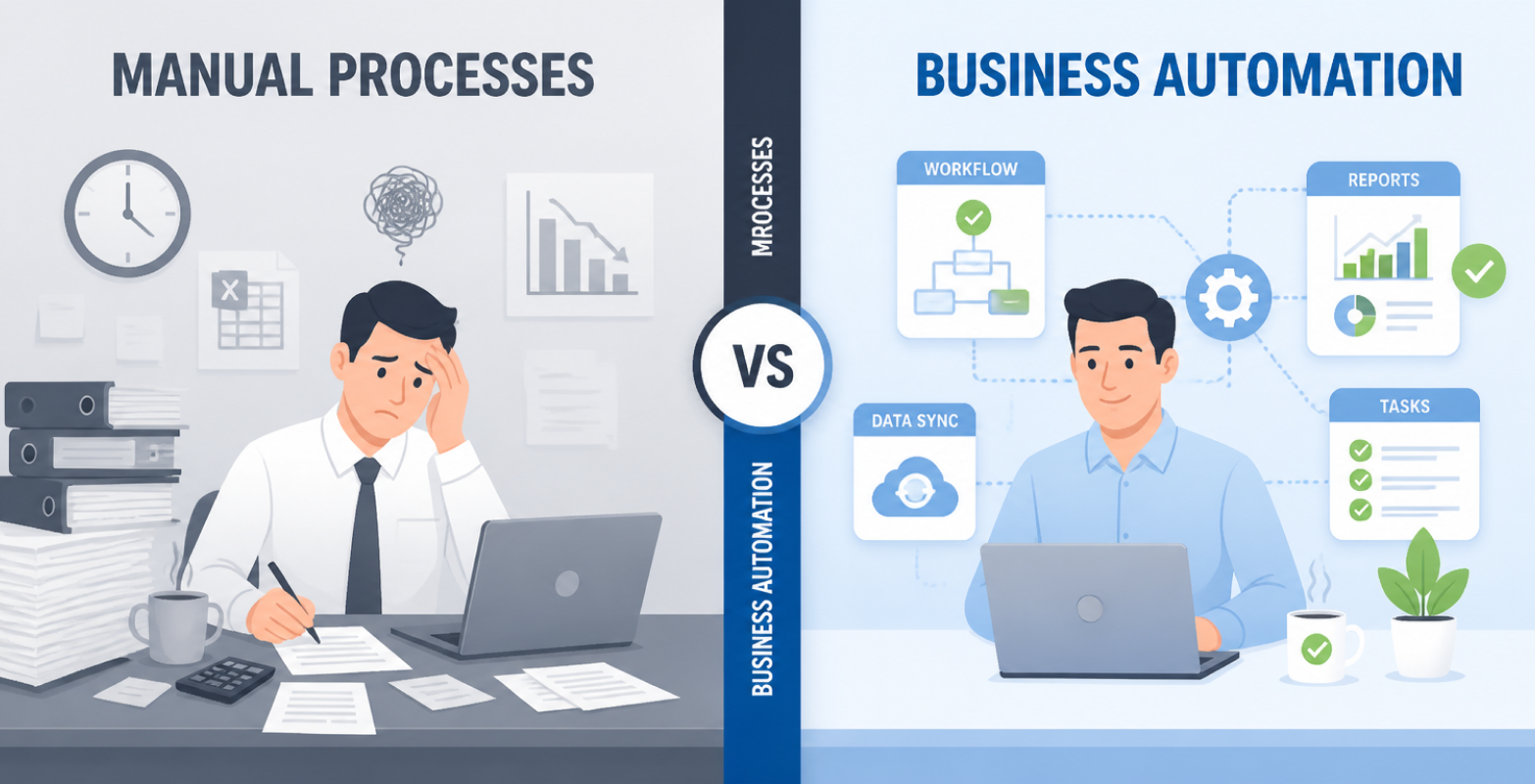
One of the most common sources of operational errors is repetitive data entry. In manual environments, employees often enter the same information into multiple systems. A sales order may need to be recorded separately in CRM software, accounting tools, inventory systems, and reporting spreadsheets.
Each manual transfer increases the risk of:
- typing mistakes
- duplicate records
- outdated information
- inconsistent formatting
Workflow automation reduces these issues by synchronising systems and transferring information automatically.
For example:
- customer information entered in one platform updates connected systems automatically
- invoices generate directly from approved sales orders
- inventory levels adjust automatically after purchases
This reduces duplication and improves data consistency across departments.
Improving Approval Accuracy and Process Consistency
Approval workflows are another area where operational errors commonly occur.
Manual approvals often depend on:
- email forwarding
- verbal confirmation
- spreadsheet tracking
- individual follow-ups
This creates delays and uncertainty. An approval request may be overlooked, sent to the wrong person, or processed without complete information. Workflow automation structures these processes.
Instead of relying on manual coordination:
- approvals are routed automatically
- stakeholders receive notifications instantly
- escalation rules apply when delays occur
- status updates remain visible in real time
This improves both speed and accountability. More importantly, it ensures that approvals follow the same operational logic every time.
Standardising Repetitive Operational Tasks
Many business activities follow predictable patterns.
Examples include:
- onboarding new employees
- processing purchase requests
- generating recurring reports
- customer ticket routing
- payment follow-ups
When these tasks are handled manually, process variation increases. Different employees may complete the same process differently. Steps may be skipped unintentionally, documentation may vary, and timelines may become inconsistent. Workflow automation standardises these activities.
The system defines:
- sequence of actions
- required approvals
- mandatory documentation
- notification timing
This improves operational reliability because processes become structured rather than dependent on individual execution styles.
How Automation Improves Cross-Department Coordination
Operational errors often emerge at the points where departments interact.
For example:
- sales teams may not communicate updates to finance
- procurement teams may not receive inventory changes immediately
- support teams may lack visibility into customer transactions
Disconnected communication creates delays and inconsistencies. Workflow automation improves coordination by connecting operational stages across departments.
When systems are integrated:
- updates happen automatically
- shared records remain consistent
- teams access the same information in real time
This reduces the need for repeated manual verification. As workflows become more connected, operational alignment improves naturally.
Workflow Visibility and Error Detection

Another major advantage of automation is visibility. In manual environments, tracking workflow progress can be difficult. Managers often rely on periodic updates or manual reporting to understand whether processes are functioning correctly.
Automated systems provide real-time visibility into:
- workflow status
- pending approvals
- delayed actions
- completed tasks
- operational bottlenecks
This visibility helps organisations identify issues before they escalate. For example, if approval requests remain pending beyond expected timelines, automated alerts can highlight the delay immediately. Instead of discovering operational problems after they affect outcomes, businesses can respond proactively.
Reducing Dependency on Individual Knowledge
Manual workflows often depend heavily on employees understanding internal procedures from experience. Over time, certain individuals become central to operational continuity because they know:
- approval structures
- reporting methods
- process exceptions
- coordination steps
This creates organisational risk. If key employees leave or become unavailable, workflows may slow down significantly. Workflow automation reduces this dependency by embedding process logic into systems.
The workflow itself defines:
- who approves tasks
- what actions happen next
- which notifications are triggered
- how exceptions are handled
This creates more stable operational continuity across teams.
Workflow Automation and Integrated Business Systems
Workflow automation becomes significantly more effective when connected to integrated business platforms such as ERP and CRM systems. In disconnected environments, automation may still require manual intervention because information remains isolated across departments. However, when workflows operate within integrated systems, operational data moves automatically between functions.
For example:
- a confirmed sales order can automatically update inventory levels
- finance teams can receive invoice data instantly
- procurement workflows can trigger when stock thresholds are reached
- customer service teams can access transaction history in real time
This level of coordination reduces delays caused by manual communication. Many organisations exploring operational efficiency improvements begin by evaluating the best ERP software in India, particularly solutions that support workflow automation across departments. The goal is not simply to digitise tasks but to create connected operational environments where processes function consistently. Integrated automation improves both speed and data reliability because updates occur simultaneously across systems.
Improving Customer Experience Through Process Accuracy
Operational errors often affect customers directly. Delayed responses, incorrect invoices, missed follow-ups, and inconsistent communication usually originate from workflow inefficiencies behind the scenes. Workflow automation improves customer experience by reducing these inconsistencies.
For example:
- support tickets can be assigned automatically based on category
- customer notifications can be triggered at specific stages
- payment reminders can be scheduled systematically
- service requests can follow predefined escalation paths
This creates more predictable interactions.
Customers experience:
- faster response times
- more accurate information
- fewer repeated explanations
- greater process consistency
In competitive markets, operational accuracy becomes part of customer trust. Businesses that reduce internal errors often improve external reliability as well.
How Automation Supports Compliance and Audit Readiness
Compliance requirements often involve detailed documentation and process accountability. Manual workflows make compliance management more difficult because records may be incomplete, inconsistent, or difficult to trace. Workflow automation improves this by maintaining structured records of operational activity.
Automated systems can:
- log approval histories
- track document changes
- maintain timestamps for actions
- enforce mandatory process steps
- generate audit trails automatically
This improves transparency.
For businesses operating in regulated industries, automated workflows reduce the risk of missing critical compliance procedures. Audit preparation also becomes more efficient because information is already organised within the system. Instead of reconstructing process history manually, businesses can access structured records directly.
Reducing Operational Bottlenecks
As organisations grow, operational bottlenecks become more difficult to identify manually.
Processes may slow down because:
- approvals remain pending
- communication gaps occur between departments
- task ownership becomes unclear
- workload distribution becomes uneven
Without visibility, these issues continue unnoticed until they begin affecting productivity. Workflow automation improves bottleneck identification because processes become measurable.
Managers can monitor:
- average approval times
- delayed workflow stages
- incomplete tasks
- recurring process interruptions
This allows businesses to refine workflows continuously. Instead of relying on assumptions about operational efficiency, organisations gain measurable insight into where delays occur.
Workflow Automation and Scalability
One of the most important long-term advantages of automation is scalability. Manual processes may function adequately when operational volume is limited. However, as businesses grow, the same workflows become increasingly difficult to manage.
For example:
- more transactions require more approvals
- more employees require more onboarding coordination
- more customers generate more support requests
Without automation, operational complexity increases proportionally with growth. Workflow automation changes this relationship.
Once workflows are structured:
- repetitive actions happen automatically
- communication triggers remain consistent
- process rules scale with operational volume
This allows businesses to expand without increasing administrative burden at the same rate. Scalability becomes more sustainable because systems absorb operational complexity more effectively.
The Relationship Between Automation and Employee Productivity
A common misconception is that workflow automation exists primarily to reduce workforce involvement. In practice, automation is more effective when viewed as a productivity support system.
Employees often spend significant time on:
- repetitive approvals
- manual tracking
- status updates
- information transfer between systems
These tasks consume operational time without contributing directly to strategic outcomes.
Automation allows teams to focus on:
- analysis
- customer interaction
- process improvement
- decision-making
This improves productivity not because employees work harder, but because they spend less time managing administrative repetition. Operational quality improves when skilled employees are not overloaded with manual coordination tasks.
Why Businesses Delay Automation Initiatives
Despite the advantages, many organisations delay workflow automation adoption. One reason is the assumption that automation requires large-scale operational change. Businesses often believe that implementing automation will disrupt existing processes or require complete system replacement. Another reason is that inefficiencies develop gradually. Teams adapt to manual workarounds over time, making operational friction appear normal.
However, delaying automation usually increases complexity later.
As workflows expand:
- more systems become involved
- more data accumulates
- more process dependencies emerge
This makes future automation initiatives more difficult and resource-intensive. Businesses that address workflow inefficiencies earlier often experience smoother operational scaling.
Long-Term Operational Stability Through Automation
Workflow automation is ultimately about creating operational consistency. Businesses do not scale effectively through isolated efficiency improvements alone. Sustainable growth depends on processes functioning reliably across departments and operational stages.
Automation supports this by:
- reducing variation
- improving visibility
- strengthening accountability
- maintaining process consistency
Over time, these improvements create operational stability. Departments coordinate more effectively, information flows more accurately, and businesses gain greater confidence in their internal systems. This stability becomes especially important during expansion, where operational complexity naturally increases.
Conclusion
Operational errors are often the result of fragmented workflows, repetitive manual processes, and inconsistent coordination between systems and departments. While these issues may appear manageable initially, they become increasingly difficult to control as organisations grow. Workflow automation addresses these challenges by introducing structured processes that reduce variation, improve visibility, and maintain operational consistency. By automating repetitive actions and integrating workflows across departments, businesses can minimise errors while improving efficiency and scalability.
At IPIX, workflow automation is approached as part of a broader operational strategy focused on long-term efficiency and system integration. As an experienced IT company in India, IPIX helps organisations build structured digital environments that reduce operational friction, improve process accuracy, and support sustainable business growth.














































 Talk to our Expert