How to Measure the ROI of Your Learning Management System
Posted on : 13 July, 2026
Businesses today invest significantly in employee training and development. Whether the goal is improving productivity, ensuring compliance, onboarding new employees, or developing leadership skills, training has become an essential part of long-term business growth. As organisations continue adopting digital learning platforms, Learning Management Systems (LMS) have become central to managing and delivering these training initiatives. However, implementing an LMS is only the first step.
Many organisations successfully launch learning platforms but struggle to answer a critical business question: Is the investment actually delivering measurable value?
This is where Return on Investment (ROI) becomes important. Measuring the ROI of a Learning Management System helps businesses understand whether their training initiatives are contributing to operational efficiency, employee performance, and business growth. Rather than focusing only on course completion rates, organisations can evaluate how learning influences productivity, reduces costs, improves knowledge retention, and supports long-term organisational objectives. Understanding LMS ROI allows decision-makers to move beyond assumptions and make data-driven improvements to their learning strategy.
What Does LMS ROI Actually Mean?
Return on Investment, commonly known as ROI, measures the value generated compared to the resources invested. In the context of a Learning Management System, ROI extends beyond financial calculations. While cost savings remain important, businesses should also evaluate operational improvements, employee development, and organisational performance. An LMS creates value in multiple ways. Financial ROI may include reducing instructor fees, travel expenses, classroom costs, and printed training materials.
Operational ROI focuses on improvements such as faster onboarding, reduced administrative effort, and improved process consistency. Learning ROI measures whether employees are gaining the knowledge and skills required to perform their roles more effectively. Business ROI examines how training contributes to broader organisational objectives, including productivity, customer satisfaction, compliance, and employee retention. Looking at ROI from these different perspectives provides a more complete understanding of how a Learning Management System contributes to business success.
Why Measuring LMS ROI Matters
Many organisations evaluate training success by looking only at completion certificates or attendance reports. Although these metrics provide useful information, they do not explain whether employees are actually applying what they have learned. ROI measurement shifts the focus from activity to outcomes.
It helps organisations answer important questions such as:
- Are employees becoming productive faster?
- Has training reduced operational errors?
- Are compliance requirements being met more consistently?
- Is employee performance improving after training?
- Is the organisation reducing long-term training costs?
Without measuring these outcomes, businesses may continue investing in learning programs that deliver limited value. Regular ROI evaluation also supports better decision-making. Learning teams can identify which courses generate the strongest results, update underperforming training programs, and allocate resources more effectively. This continuous improvement approach ensures that training evolves alongside changing business needs.
Key Metrics That Measure LMS ROI
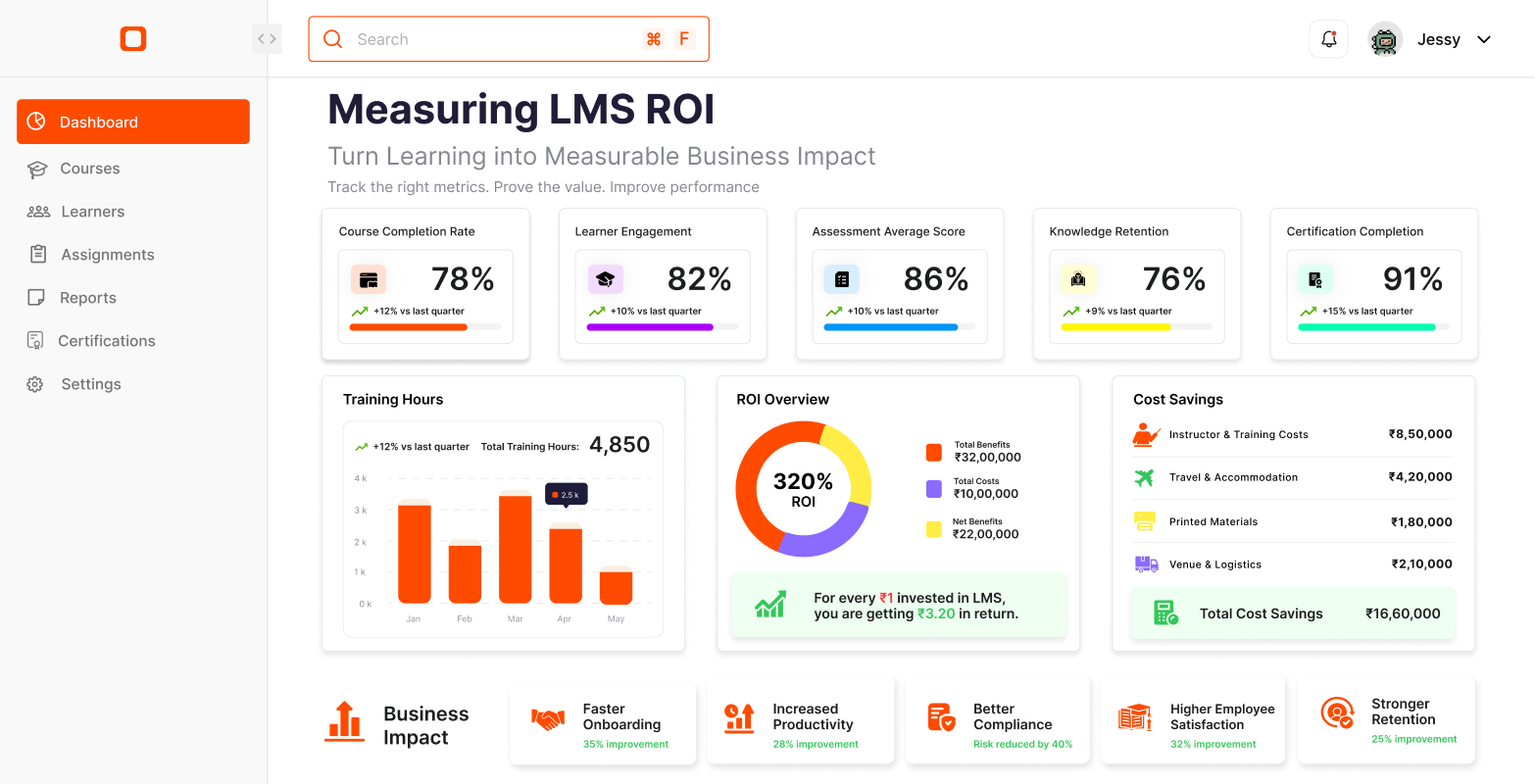
A successful LMS generates measurable improvements across multiple areas of the organisation. Instead of relying on a single performance indicator, businesses should monitor a combination of learning, operational, and financial metrics.
Course Completion Rates
Completion rates provide a basic indication of learner engagement. If employees consistently abandon courses before finishing them, businesses should investigate whether the learning content is relevant, engaging, or appropriately structured. However, completion alone does not guarantee learning success. Employees may complete courses without fully understanding the material. Completion rates should therefore be considered alongside other performance indicators.
Knowledge Retention
Effective training should improve long-term understanding rather than short-term memorisation. Businesses can measure retention through:
- follow-up assessments
- practical assignments
- manager evaluations
- periodic refresher tests
Improved knowledge retention often leads to better workplace performance.
Employee Productivity
One of the strongest indicators of LMS ROI is productivity improvement. Training should help employees perform tasks more efficiently, reduce dependency on supervision and increase confidence in daily responsibilities.
For example, organisations may observe:
- faster task completion
- improved software adoption
- fewer operational delays
- better decision-making
These improvements often generate measurable business value over time.
Compliance Completion
Many industries require employees to complete mandatory training programs. An LMS simplifies compliance tracking by recording participation, assessment scores, and certification status. Higher compliance completion rates reduce organisational risk while simplifying audit preparation.
Employee Engagement
Modern Learning Management Systems provide insights into learner behaviour. Businesses can monitor:
- login frequency
- time spent learning
- assessment participation
- discussion activity
- voluntary course enrolment
Higher engagement often indicates that employees find the learning environment useful and relevant.
How LMS Reduces Training Costs
One of the most visible financial benefits of an LMS is cost reduction. Traditional training often involves significant recurring expenses.
These may include:
- instructor fees
- travel costs
- venue rental
- accommodation
- printed materials
- repeated classroom sessions
Digital learning significantly reduces many of these expenses. Once learning content has been developed, it can be delivered repeatedly without recreating the same training experience for every new employee. This scalability improves long-term cost efficiency. Businesses also save valuable administrative time because course enrollment, reminders, assessments, certifications, and reporting can all be managed through the LMS. Over time, these efficiencies contribute substantially to overall ROI.
Measuring Productivity Improvements
Productivity improvements often represent the greatest long-term value created by an LMS. Well-trained employees generally perform their responsibilities with greater confidence and consistency. For example, structured onboarding programs help new employees understand organisational processes more quickly. Instead of relying on repeated manual guidance, employees can complete role-specific learning paths that prepare them for daily responsibilities.
Businesses interested in improving onboarding efficiency can also explore How LMS Supports Faster Employee Onboarding, where structured digital learning significantly reduces the time required for new employees to become productive. Learning also reduces operational disruptions caused by inconsistent knowledge. Employees who understand procedures clearly are less likely to make errors, require repeated supervision, or delay business processes. These improvements may appear incremental individually, but collectively they contribute significantly to organisational performance.
Using AI and Analytics to Measure LMS ROI
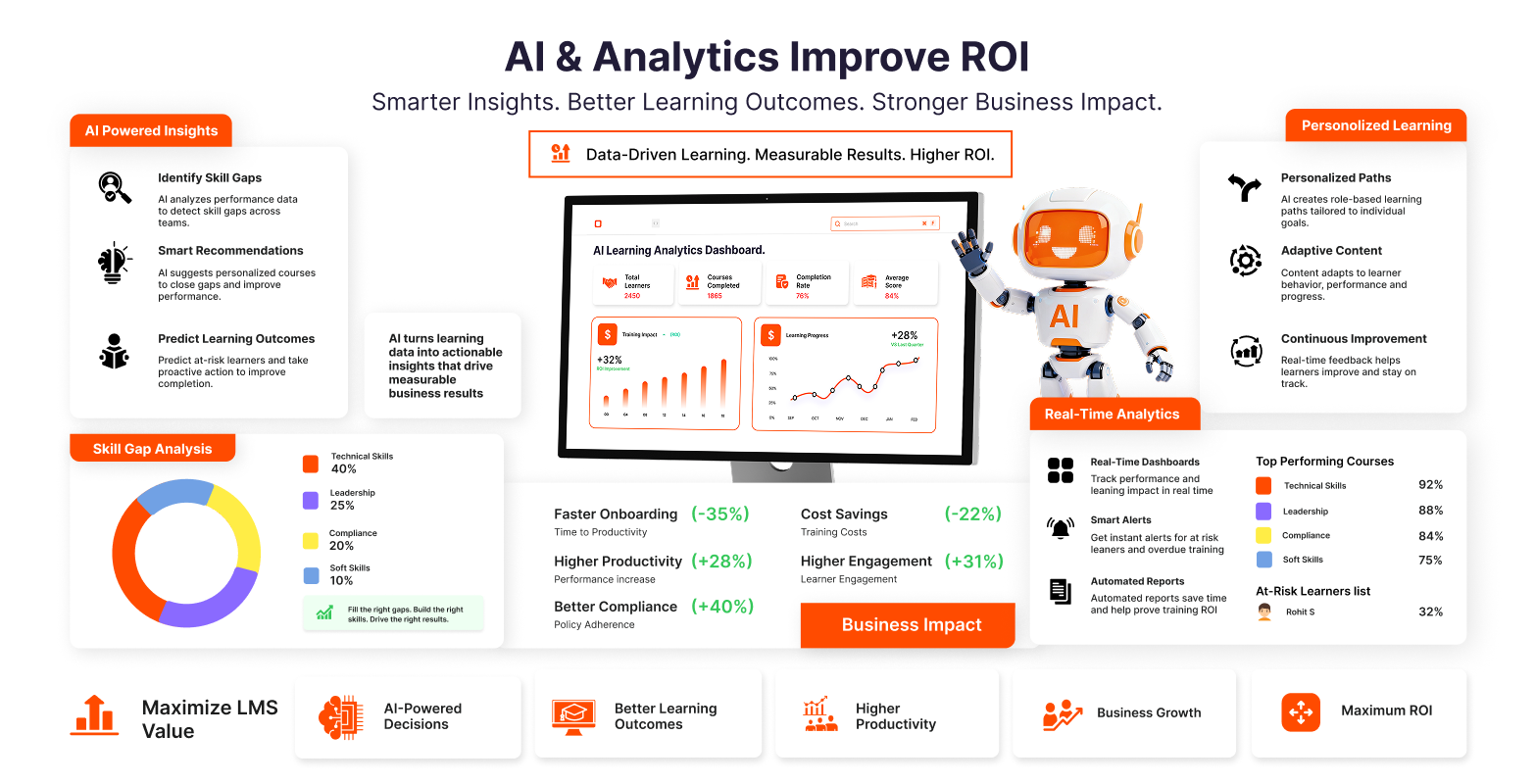
Modern Learning Management Systems provide much more than course delivery. They generate valuable data that helps organisations understand how employees learn, where they struggle, and how training contributes to business performance. Instead of relying on assumptions, organisations can use analytics to evaluate measurable outcomes.
Most enterprise LMS platforms provide dashboards that display:
- course completion rates
- assessment performance
- certification status
- learner engagement
- time spent on courses
- department-wise training progress
These insights allow HR teams and learning managers to identify patterns that may otherwise go unnoticed. For example, if employees consistently spend more time completing a particular module or repeatedly fail the same assessment, it may indicate that the content requires improvement. Similarly, if one department shows significantly lower engagement than others, businesses can investigate whether the learning material is relevant to their daily responsibilities.
Artificial intelligence is making these analytics even more valuable. AI-powered learning systems can identify skill gaps, recommend personalized learning paths, predict training completion risks, and suggest content improvements based on learner behaviour. Rather than reviewing reports manually, businesses receive actionable insights that help improve learning outcomes. This shift towards intelligent analytics is also transforming digital learning environments, as explored in How AI is Transforming Modern Learning Management Systems, where AI supports personalised learning and continuous employee development.
Common Mistakes When Measuring LMS ROI
Many organisations invest in Learning Management Systems but fail to measure their actual impact accurately. One of the most common mistakes is focusing only on course completion rates. Completing a course does not necessarily mean employees have understood or applied the knowledge in their daily work. Learning effectiveness should always be evaluated alongside workplace performance and behavioural improvements. Another common mistake is measuring ROI immediately after implementation. Training benefits often become visible gradually. Employees require time to apply new knowledge, improve performance, and influence operational outcomes. Measuring ROI too early may underestimate the value of the LMS.
Some organisations also ignore employee feedback. While analytics provide quantitative information, learner feedback offers valuable qualitative insights into course relevance, usability, and engagement. Combining both forms of evaluation provides a more balanced understanding of training effectiveness. Another challenge is failing to define measurable objectives before implementation. Without clear KPIs, organisations struggle to determine whether training has achieved its intended outcomes.
Examples of meaningful KPIs include:
- reducing onboarding time
- increasing certification completion
- improving customer service scores
- decreasing compliance violations
- reducing operational errors
When success is clearly defined, ROI becomes much easier to evaluate.
Best Practices for Maximising LMS ROI
Measuring ROI is only one part of the process. Businesses also need strategies that continuously improve learning effectiveness over time. One of the most effective approaches is to establish clear learning objectives before creating any course. Every training programme should answer one question:
What business outcome should this learning improve?
The objective may be improving software adoption, increasing product knowledge, reducing compliance risks, or strengthening customer service skills. Once objectives are defined, learning content should be reviewed regularly. Business processes change, technologies evolve, and industry regulations are updated. Training content must reflect these changes to remain valuable. Personalisation also plays an important role. Employees learn at different speeds and have different responsibilities. Modern LMS platforms allow organisations to create role-based learning paths that provide relevant content instead of delivering identical training to every employee.
Regular reporting should also become part of organisational routines. Instead of reviewing LMS performance only during annual evaluations, businesses should analyse learning metrics monthly or quarterly. Continuous monitoring helps organisations identify opportunities for improvement before learning effectiveness begins to decline.
Building a Long-Term Learning Strategy
Many organisations initially adopt an LMS to solve a single challenge, such as employee onboarding or compliance training. However, the greatest value of a Learning Management System is realised when it becomes part of a broader organisational learning strategy. An LMS can support every stage of the employee lifecycle. From onboarding and role-specific training to leadership development and continuous professional learning, the platform provides a central environment for knowledge sharing and skill development.
As organisations grow, this consistency becomes increasingly valuable. Employees across multiple locations can receive the same quality of training, follow structured learning paths, and access updated resources whenever needed. This creates greater operational consistency while reducing dependence on repeated instructor-led training sessions. Businesses should also view learning as an ongoing process rather than a one-time activity. Regular upskilling helps employees adapt to new technologies, changing customer expectations, and evolving business objectives. When supported by measurable analytics, continuous learning contributes directly to organisational resilience and long-term competitiveness.
Measuring ROI Beyond Financial Savings
Financial savings remain an important part of ROI, but they should not become the only measurement. Many of the most valuable benefits created by an LMS are operational rather than purely financial.
These include:
- faster employee onboarding
- stronger compliance management
- improved collaboration
- higher employee confidence
- better customer interactions
- increased knowledge retention
- reduced process inconsistencies
- stronger organisational agility
Although these outcomes may not always appear immediately in financial reports, they contribute significantly to overall business performance. Businesses that evaluate both financial and operational outcomes develop a much clearer understanding of the true value generated by their learning investment.
The Future of LMS ROI
Learning Management Systems continue to evolve beyond traditional training platforms. Artificial intelligence, predictive analytics, adaptive learning, and intelligent automation are making LMS platforms increasingly capable of supporting strategic business objectives. Future LMS environments will not simply record learning activity.
They will help organisations:
- predict skill shortages
- recommend personalised development plans
- identify future workforce requirements
- measure business impact more accurately than ever before
As these capabilities mature, ROI measurement will shift from retrospective reporting to proactive decision-making. Businesses will increasingly use LMS analytics to guide workforce development strategies rather than simply evaluate completed training programmes. This evolution positions the Learning Management System as a strategic business platform rather than just a digital training repository.
Conclusion
Measuring the ROI of a Learning Management System goes beyond calculating financial returns. It involves evaluating how effectively training improves employee performance, operational efficiency, knowledge retention, and overall business productivity. Organisations that regularly measure learning outcomes are better positioned to optimise training programmes, allocate resources effectively, and build a culture of continuous improvement. An LMS delivers its greatest value when learning is aligned with business objectives and supported by meaningful analytics. By tracking the right performance indicators and continuously refining training strategies, businesses can transform learning from a routine activity into a measurable driver of organisational growth.
At IPIX, we believe that an effective LMS should do more than deliver training it should provide actionable insights that help organisations continuously improve workforce performance. Businesses looking for Learning Management System Software in India should consider solutions that combine advanced analytics, automation, scalability, and personalised learning experiences to maximise training ROI and support long-term business success.





































 Talk to our Expert