Why Businesses Are Moving from Manual Processes to ERP Systems
Posted on : 27 March, 2026
Businesses often begin their operations with simple tools. Spreadsheets, email communication, and manual documentation are usually sufficient when teams are small and operations are limited. In the early stages, these tools feel flexible and easy to manage. However, as organisations grow, operational complexity increases. More departments are involved in daily processes, data flows across multiple systems, and decision-making requires accurate information from different sources. At this point, manual workflows start creating inefficiencies that affect productivity and visibility.
Enterprise Resource Planning (ERP) systems address this challenge by integrating core business processes within a single platform. Instead of managing separate tools for finance, inventory, sales, and operations, ERP systems centralise data and automate workflows across departments. For many organisations, the move from manual processes to ERP systems represents a natural stage of operational maturity.
Why Manual Processes Become a Limitation

Manual systems may appear manageable in the early stages of business growth. However, over time they introduce several structural limitations. One of the most common issues is data fragmentation. Information often exists across spreadsheets, emails, and individual documents. When departments maintain their own records independently, inconsistencies begin to appear. A sales team may record data differently from the finance department, and inventory figures may not match procurement records.
Another limitation is repeated data entry. Employees frequently transfer information from one system to another. This duplication increases the risk of human error and consumes valuable time that could otherwise be used for more strategic tasks. Manual processes also make it difficult to maintain a clear overview of operations. Managers often need to gather information from multiple sources before making decisions. By the time the data is compiled, it may already be outdated. As organisations expand, these inefficiencies gradually slow down operations and create barriers to growth.
The Hidden Cost of Manual Workflows
The challenges created by manual workflows are not always immediately visible. At first, they appear as minor operational inconveniences. Over time, however, they begin to affect productivity and performance in measurable ways. One of the most significant costs is process delay. When tasks depend on manual approvals or information transfers between departments, operations slow down. For example, an order may require confirmation from inventory, finance, and logistics teams before it can be processed. Without a centralised system, this coordination takes longer.
Another issue is limited visibility into business performance. Decision-makers often rely on periodic reports compiled manually. These reports may not reflect real-time conditions, making it difficult to respond quickly to operational changes.
Manual workflows also increase the likelihood of human error. Even small mistakes in data entry can create inconsistencies that affect multiple departments. Correcting these errors later can require significant time and effort. These challenges highlight why many growing businesses begin to explore structured digital solutions.
What ERP Systems Actually Change
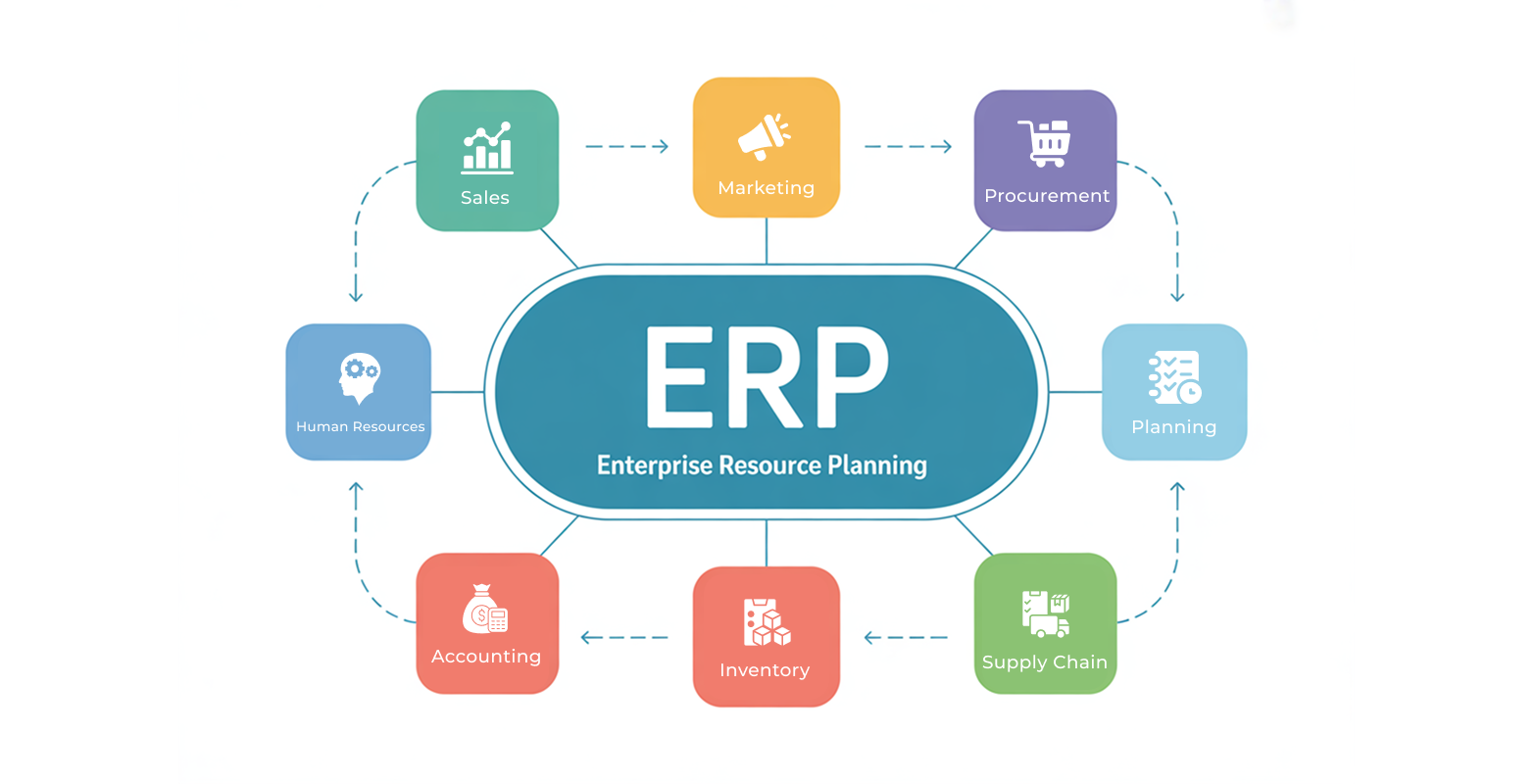
ERP systems are designed to address the fragmentation and inefficiencies associated with manual processes. Rather than introducing yet another tool into the technology stack, ERP platforms integrate multiple functions into a unified system.
At the core of an ERP system is a centralised database that stores information from different departments. Finance, sales, inventory, procurement, and operations all interact with the same data environment. This eliminates duplication and ensures that every team works with consistent information.
ERP systems also standardise workflows. Instead of relying on manual coordination between departments, processes are structured within the system itself. When an order is created, for example, the ERP platform automatically updates inventory records, generates financial entries, and triggers logistics actions. This integration allows organisations to operate with greater efficiency while maintaining a clear overview of their activities.
Why Businesses Are Prioritising ERP Adoption
Several factors are driving increased interest in ERP adoption across industries.
First, businesses are managing more complex operations than before. Even small and mid-sized organisations often operate across multiple locations, supply chains, and digital platforms. Coordinating these activities through manual systems becomes increasingly difficult.
Second, modern businesses depend heavily on data-driven decision-making. Managers require accurate and timely information to evaluate performance and plan future strategies. ERP systems provide this visibility by consolidating operational data into a single platform.
Another factor is the growing accessibility of ERP technology. In the past, ERP solutions were primarily associated with large enterprises. Today, cloud-based platforms have made ERP systems more accessible to smaller organisations as well. Businesses can adopt scalable systems without the need for extensive infrastructure investments. As a result, many organisations now view ERP not as a luxury but as an essential operational tool.
ERP and Real-Time Operational Insight
One of the most important advantages of ERP systems is the ability to access real-time information. When all departments operate within the same system, changes in one area automatically reflect across the organisation. For example, when a sale is recorded, inventory levels update immediately, financial records adjust accordingly, and procurement teams can monitor stock levels.
This real-time visibility allows businesses to respond quickly to operational developments. Managers can monitor performance indicators, identify emerging challenges, and make informed decisions without waiting for manually prepared reports.
The result is a more responsive organisation that can adapt to changing conditions with greater confidence.
ERP Beyond Large Enterprises
ERP systems were once viewed as tools designed mainly for large corporations with complex operational structures. Implementation costs, infrastructure requirements, and long deployment cycles made them difficult for smaller businesses to consider. That perception has changed significantly.
Cloud-based ERP platforms have made enterprise systems more accessible to small and medium-sized organisations. Businesses no longer need to invest heavily in on-premise infrastructure to begin using integrated systems. Instead, they can adopt modular ERP solutions that grow with operational needs.
This shift has encouraged many mid-sized businesses to move earlier toward structured digital systems rather than waiting until manual workflows become difficult to control. A growing organisation often reaches a point where spreadsheets, email approvals, and disconnected records begin slowing down everyday decisions. ERP systems offer a way to move beyond these limitations before they affect long-term efficiency.
The wider availability of flexible solutions has also increased interest in evaluating the best ERP software in India, especially among businesses looking for platforms that support local compliance requirements, operational flexibility, and scalable deployment.
How ERP Improves Department Coordination
One of the less visible but highly important benefits of ERP adoption is improved coordination between departments. In manual environments, departments often work independently. Sales teams maintain one set of records, finance teams work with another, and procurement relies on separate documentation. While each department may function effectively on its own, the lack of shared visibility creates delays whenever coordination is required.
ERP systems change this by connecting operational activities across departments.
For example:
- A confirmed sales order updates inventory automatically
- Procurement teams receive visibility into stock changes
- Finance records are updated without duplicate entry
- Management dashboards reflect the latest operational position
This shared visibility reduces internal friction. Teams no longer need to verify the same information repeatedly through email exchanges or manual reports. As businesses grow, this level of coordination becomes increasingly important because operational speed often depends on how quickly information moves across departments.
Standardisation and Process Discipline
Manual processes often develop differently across teams. Over time, departments create their own methods of recording data, approving requests, and managing workflows. This flexibility may work initially, but it often creates inconsistency. ERP systems introduce process discipline by defining how workflows should operate.
Examples include:
- approval hierarchies
- standard document formats
- automated status updates
- controlled user permissions
This standardisation improves reliability. When every department follows consistent process logic, businesses reduce variation and improve predictability. It also becomes easier to train employees, audit internal activities, and maintain compliance standards. For growing organisations, process consistency is often as important as speed.
ERP and Decision-Making Accuracy
Many strategic decisions depend on accurate operational data. Without integrated systems, managers often rely on manually prepared reports that may already be outdated by the time they are reviewed. ERP systems improve this by making live operational data available through dashboards and reporting tools.
Decision-makers can evaluate:
- revenue trends
- purchase patterns
- stock movement
- operational delays
- outstanding transactions
This allows faster response when issues emerge. For example, if procurement delays begin affecting order fulfilment, managers can identify the issue quickly and intervene before customer impact increases. Better data does not automatically guarantee better decisions, but it improves the quality of information on which decisions are based.
Common Misconceptions About ERP Adoption
Despite wider adoption, several misconceptions still delay ERP implementation. A common assumption is that ERP systems are only necessary for large enterprises. In reality, many growing businesses experience operational complexity long before they consider themselves large enough for ERP.
Another misconception is that ERP implementation always disrupts business operations. While implementation requires planning, modern ERP systems can be introduced in phases, allowing businesses to adapt gradually.
Some organisations also assume ERP systems replace teams. In practice, ERP platforms do not replace operational roles. They reduce repetitive manual coordination and improve visibility, allowing teams to work more effectively. The real value of ERP lies in improving how existing teams function together.
Long-Term Value of ERP Integration
ERP adoption should not be viewed as a short-term software purchase. Its long-term value lies in creating a structured operational foundation. Businesses that continue relying on manual systems often find that complexity increases faster than process maturity. What once seemed manageable eventually becomes difficult to scale.
ERP systems support long-term growth by:
- reducing dependence on manual intervention
- improving data consistency
- strengthening internal accountability
- enabling more predictable operations
This becomes especially important when organisations expand into new markets, add product lines, or increase operational volume. Without structured systems, growth often creates additional inefficiencies. ERP helps prevent that.
Conclusion
The movement from manual processes to ERP systems reflects a broader shift in how businesses approach operational maturity. Manual workflows may support early-stage flexibility, but they become increasingly difficult to manage as organisations expand. ERP systems provide the structure needed to integrate departments, improve visibility, and standardise workflows across operations. They allow businesses to move from fragmented data and delayed decisions toward a more coordinated operating model.
At IPIX, ERP solutions are approached as long-term operational systems rather than simple software deployments. As an established IT company in India, IPIX works with businesses to design ERP environments that improve clarity, strengthen internal coordination, and support scalable growth.




































 Talk to our Expert