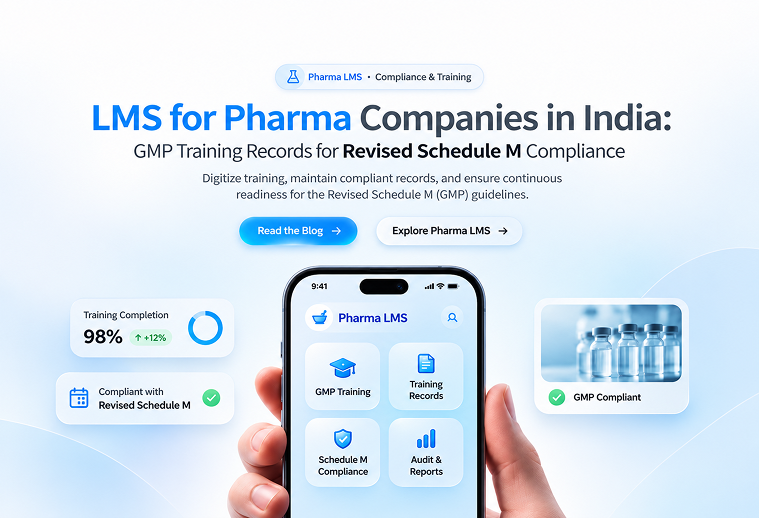
LMS for Pharma Companies in India: GMP Training Records for Revised Schedule M Compliance
Posted on : 12 November, 2026
The pharmaceutical industry depends on trained employees, consistent processes and accurate documentation. A mistake can affect product quality, patient safety and regulatory compliance, making employee training an important part of Good Manufacturing Practices (GMP).
India’s Revised Schedule M reinforces the need for qualified personnel and initial and continuing training relevant to employees’ responsibilities. Manufacturers must ensure staff understand the procedures connected with their work, not simply record attendance at induction.
For small and medium-sized units, paper registers and separate spreadsheets can make it difficult to track training across shifts, follow up after SOP changes and retrieve records for review.
A Learning Management System (LMS) for pharmaceutical companies can centralise course assignments, training material, assessments and completion records. Used alongside a manufacturer’s quality processes, it can make training administration easier to manage.
This article explains the training implications of Revised Schedule M, essential pharmaceutical LMS features and how skill gap analysis can support employee development.
1. What Revised Schedule M means for employee training
The Ministry of Health and Family Welfare notified the revised Schedule M through G.S.R. 922(E) on 28 December 2023. It updated the Good Manufacturing Practices and requirements for premises, plant and equipment under the Drugs Rules, 1945.
The revised Schedule M requires manufacturers to have sufficient personnel with appropriate qualifications and practical experience. It also states that personnel should understand the GMP principles affecting their work and receive initial and continuing training, including relevant hygiene instruction. Quality-unit responsibilities include ensuring that required training is carried out and adapted to need.
CDSCO+1
Training needs differ by site, process and job. Manufacturers should define requirements for production, QC, warehouse and maintenance roles through their quality system.
What is the implementation timeline?
Large manufacturers with turnover above ₹250 crore were required to implement the revised requirements from 29 June 2024. The government later provided a conditional extension for eligible small and medium manufacturers with turnover of ₹250 crore or less, subject to submitting an upgrade plan. That extension ran until 31 December 2025. In March 2026, the Ministry stated that revised Schedule M had become effective for manufacturers below ₹250 crore from 1 January 2026.
Press Information Bureau+1
Manufacturers should confirm their licensing category, applicable conditions and current directions with the relevant authority or a qualified compliance adviser.
2. Why manual GMP training records become difficult
Paper registers and spreadsheets may remain part of documented procedures. The challenge is keeping information complete and retrievable across departments and shifts.
In a plant with production, QA, QC, packaging and warehouse teams, training needs differ by role. When an SOP changes, the organisation must identify affected employees, assign training and check understanding. A spreadsheet may record a session without clearly showing whether every relevant employee completed the correct revision.
Common difficulties include:
- Training records spread across registers, files and department spreadsheets.
- Time spent finding employees who need initial or refresher training.
- Limited visibility into whether training improved understanding.
- Delays in preparing employee-wise evidence for reviews or inspections.
- Missed follow-ups when employees change roles, shifts or departments.
The issue is not that paper records are automatically unacceptable. Manual coordination can become resource-intensive and increase the risk of incomplete tracking. A digital system can organise the workflow, provided the manufacturer defines and controls the process. See also our guide to the hidden costs of traditional training.
3. Essential LMS features for pharmaceutical companies
A pharmaceutical LMS should support role requirements, procedures and training evidence. Ask vendors to demonstrate these workflows using realistic examples.
Role-based training matrix
A training matrix connects job roles with required learning. Production operators may need manufacturing and hygiene modules, while QC analysts may need laboratory procedures. The LMS should assign courses by role or department and show completed, pending and overdue items.
Skill gap analysis and competency tracking
Skill gap analysis compares the competencies expected for a role with an employee’s assessed capabilities. A packaging operator, for example, may need further learning on line clearance, while a new QC analyst may need support with a testing procedure. An LMS can record assessment results, identify learning needs and help managers assign targeted development.
This supports workforce planning but does not replace GMP qualification decisions or approval by authorised personnel.
SOP-linked training and retraining
When an approved SOP changes, an LMS can link retraining to its identifier and revision, assign it to affected roles and track completion. Keep the controlled SOP in the approved document-control system unless the LMS is assessed for that purpose.
Assessments, records and reporting
Attendance alone does not show understanding. Use suitable knowledge checks or practical evaluations, with defined pass criteria and reassessment rules.
Look for individual histories, course versions, completion dates, assessment results and reports. Ask how the system logs activity and corrections. Do not assume audit trails or electronic signatures are compliant without product-specific evidence and an intended-use assessment.
4. Where an LMS supports daily pharma training
A pharmaceutical LMS can support recurring activities when aligned with site procedures.
New-employee induction: Assign GMP, hygiene, safety and role-specific learning, then review completion before employees perform tasks requiring training or authorisation.
SOP revision training: When QA approves a revision, assign learning to affected roles and record the SOP version covered.
CAPA-related learning: If an investigation identifies a training gap, targeted learning may form part of corrective action. QA must still assess the root cause and verify effectiveness.
Refresher programmes: Schedule recurring topics according to company procedures and risk assessment, with reminders for employees and managers.
Shop-floor learning: Mobile-friendly modules can support shift workers. Regional-language content may improve understanding, provided technical translations are reviewed by competent personnel.
5. Off-the-shelf LMS or custom software?
An off-the-shelf LMS may suit manufacturers needing standard courses, assessments, user management and reports, provided it supports their training matrix and procedures.
A custom solution may be preferable for specialised approval flows, multiple sites, HR or ERP integration, or tailored competency reporting. Explore IPIX software development services for specific digital workflows.
Compare configuration, migration, integration, training, support and any required system assessment or validation—not just the licence fee. Read about modern LMS features and measuring LMS ROI.
6. What about FDA 21 CFR Part 11 and EU Annex 11?
Exporters may also need to consider electronic records and signatures in destination markets. US FDA 21 CFR Part 11 applies within its scope, while EU GMP Annex 11 addresses computerised systems. These frameworks are not interchangeable with Indian Schedule M.
CDSCO+1
A login or digital acknowledgement does not prove compliance. Assess intended use, access controls, audit trails, record protection, signature controls and validation responsibilities with qualified specialists. Verify product capabilities before making compliance claims.
7. Implementation checklist for pharma training teams
Bring QA, HR, IT and department heads together. Map the current process and agree what the platform must support.
- Map departments, roles and required GMP, hygiene and SOP learning.
- Define course approval, assignment and assessment responsibilities.
- Decide how SOP revisions trigger retraining.
- Set refresher schedules, permissions and retention requirements.
- Test reports with real employee scenarios.
- Review vendor security, backups, support and change management.
- Assess the system for its intended use before relying on electronic records.
Pilot one department first, gather feedback and resolve gaps before wider rollout. QA must own quality requirements; a software provider cannot determine GMP compliance.
8. Frequently asked questions
What is an LMS for pharmaceutical companies?
It assigns employee learning, delivers material, conducts assessments and maintains training histories for GMP, SOP, hygiene, safety and role-specific topics.
Does Revised Schedule M make an LMS mandatory?
No. Schedule M sets personnel and training expectations but does not prescribe a software platform. An LMS is one way to organise the work.
Can an LMS replace paper GMP training records?
Possibly, after the manufacturer assesses the system for intended use and establishes suitable procedures and controls. A vendor feature alone is not enough.
How does skill gap analysis help pharma companies?
It compares role requirements with assessed employee capabilities to identify targeted learning needs. It does not replace formal qualification or authorisation.
Does IPIX LMS support audit trails and electronic signatures?
Confirm with the IPIX product team and review functionality, configuration and validation evidence for the intended use.
9. Improve GMP training management with the right LMS
Revised Schedule M makes suitable personnel and relevant initial and continuing training important parts of a pharmaceutical manufacturer’s quality system. As teams and procedures grow, manual training administration can become harder to coordinate.
A well-selected LMS can organise role-based learning, assessments, competency insights and completion reports. It supports training management but does not replace QA oversight, controlled SOP management or the manufacturer’s regulatory responsibilities.
IPIX Technologies offers Learning Management System Software in India. Pharmaceutical manufacturers can discuss training matrices, SOP retraining and reporting needs with the team. For platform comparisons, read LMS versus Training Management Systems.
Want to improve GMP training management? Book a 20-minute GMP training demo with IPIX Technologies to discuss your requirements.
Disclaimer: This article is for general information and is not regulatory or legal advice. Manufacturers should confirm applicable requirements with qualified pharmaceutical quality and regulatory professionals. IPIX LMS capabilities must be verified with the product team before being relied on for regulated records.





























 Talk to our Expert