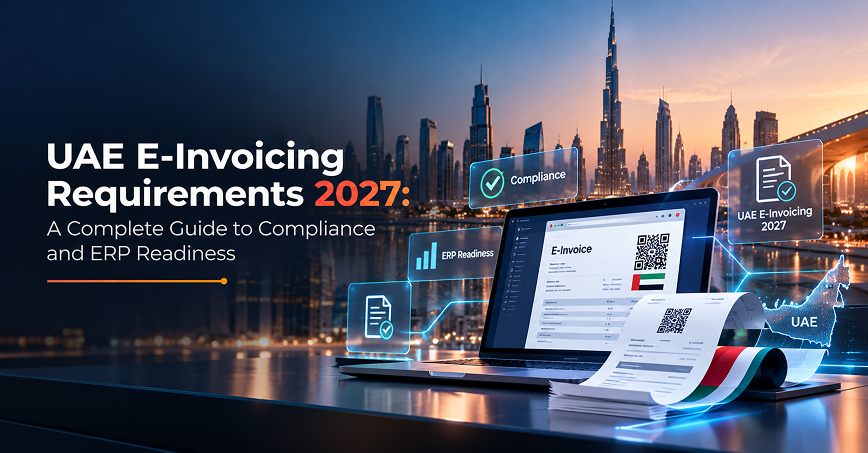
UAE E-Invoicing Requirements 2027: A Complete Guide to Compliance and ERP Readiness
Posted on : 27 October, 2026
For businesses operating in the United Arab Emirates, invoicing is becoming more than an administrative task. As the country moves towards a structured electronic invoicing system, companies need to review how they create invoices, exchange financial information and manage their accounting processes.
The UAE's e-invoicing programme introduces a standardised way to issue, transmit, exchange and report invoice data electronically. The transition is designed to support greater transparency, improve the accuracy of business transactions and reduce manual work across financial operations.
One important distinction is that a PDF invoice is not the same as a structured electronic invoice under the UAE's e-invoicing framework. A PDF may be perfectly suitable for viewing or sharing documents in many existing workflows, but simply sending a PDF by email does not satisfy the framework's definition of an e-invoice.
The UAE Ministry of Finance has established a phased implementation schedule, with mandatory implementation beginning in January 2027 for the first group of in-scope businesses. Other businesses and government entities will follow according to their respective deadlines.
For business owners, finance managers and IT teams, the time to assess existing invoicing processes is now. Understanding the requirements, reviewing software capabilities and planning the necessary integrations can help make the transition more manageable.
In this guide, we explain the UAE e-invoicing requirements for 2027, the difference between PDF and structured invoices, the implementation timeline, and the role of ERP and accounting software in preparing for the change.
What Is UAE E-Invoicing?
Electronic invoicing, commonly called e-invoicing, is the process of issuing and exchanging invoice information electronically in a structured format that allows systems to process the data automatically.
Unlike a conventional document that primarily presents information for people to read, a structured e-invoice contains organised data that compatible software can interpret. This supports automated processing, validation, exchange and reporting.
According to the UAE Ministry of Finance, an e-invoice is structured invoice data issued and exchanged electronically between a supplier and a buyer and reported electronically to the Federal Tax Authority (FTA), in accordance with the applicable framework.
The UAE is adopting the Peppol-based framework to facilitate standardised invoice exchange through Accredited Service Providers (ASPs).
Under this approach, businesses need to consider not only how invoices appear to customers but also how their financial systems generate and exchange the underlying data.
Why Is the UAE Introducing E-Invoicing?
The transition forms part of the UAE's wider digital transformation initiatives. A standardised electronic invoicing framework can help businesses and authorities improve the quality and consistency of transaction data.
Key objectives include:
- Improved accuracy: Structured information can reduce errors caused by manual data entry.
- Greater transparency: Standardised transaction data supports clearer financial records.
- Faster processing: Compatible systems can exchange and process invoice information with less manual intervention.
- Better operational efficiency: Automation can reduce repetitive administrative work.
- Stronger tax administration: Standardised reporting supports the UAE's tax compliance framework.
- Digital business operations: Companies can modernise invoicing workflows and integrate financial processes with existing business software.
For companies that manage a high volume of business transactions, these changes also create an opportunity to review outdated accounting practices and improve how different departments handle financial information.
PDF Invoices vs Structured E-Invoices: What Is the Difference?
Many businesses currently generate invoices using accounting applications, spreadsheets, word processors or billing software. These invoices may be saved as PDFs and sent to customers by email.
Although this process is digital in the everyday sense, it does not automatically qualify as electronic invoicing under the UAE's structured framework.
The distinction lies in the invoice data and how it is exchanged.
| Feature | Conventional PDF invoice | Structured e-invoice |
|---|---|---|
| Main format | Document designed for viewing | Structured, machine-processable data |
| Human readability | Usually straightforward | Can be rendered into a readable format |
| Automated processing | May require manual entry or extraction | Designed for automated processing |
| Standardised data exchange | Not inherently supported | Follows the applicable technical framework |
| Reporting and integration | Depends on separate systems and processes | Supports system-to-system exchange and reporting |
| UAE e-invoicing framework | A PDF alone is not a compliant structured e-invoice | Must meet the applicable technical and legal requirements |
A PDF can still serve as a readable representation of an invoice. However, sending or receiving that PDF alone does not replace the required structured invoice exchange for transactions that fall within the mandatory system.
This distinction is important because businesses may assume their existing invoicing process is ready simply because invoices are already generated electronically.
Before making changes, companies should assess whether their current software can produce the required structured data and connect with an appropriate service provider.
UAE E-Invoicing Deadlines for 2027
The UAE is implementing e-invoicing in phases. The applicable timeline depends on the type of entity, revenue threshold and scope of the regulations.
As of October 2026, the published implementation schedule is as follows.
| Business category | Deadline to appoint an ASP | Mandatory implementation |
|---|---|---|
| In-scope businesses with annual revenue of AED 50 million or more | 30 October 2026 | 1 January 2027 |
| In-scope businesses with annual revenue below AED 50 million | 31 March 2027 | 1 July 2027 |
| In-scope government entities | 31 March 2027 | 1 October 2027 |
These dates reflect the UAE Ministry of Finance and Federal Tax Authority's published guidance. Businesses should check the official portal for any subsequent amendments and confirm which phase applies to their circumstances.
Phase One: Businesses With Revenue of AED 50 Million or More
Businesses within the first phase must appoint an Accredited Service Provider by 30 October 2026 and implement the e-invoicing system by 1 January 2027.
For affected organisations, preparation should already include reviewing current software, identifying integration requirements and coordinating with the selected service provider.
Waiting until the implementation date approaches can create avoidable pressure on finance and IT teams, particularly where legacy systems or multiple invoicing applications are involved.
Phase Two: Businesses With Revenue Below AED 50 Million
The next phase covers in-scope businesses with annual revenue below AED 50 million. These businesses must appoint an ASP by 31 March 2027 and implement the system by 1 July 2027.
Although these organisations have a later implementation date, early planning remains important. Reviewing invoice data, accounting workflows and software compatibility in advance can help identify issues before technical integration begins.
Government Entities
In-scope government entities have a mandatory implementation date of 1 October 2027, with an ASP appointment deadline of 31 March 2027.
Organisations should verify their classification and applicable requirements rather than assuming that the general business timeline applies to them.
Does the System Apply to Every Business Transaction?
Not necessarily. The framework has defined scope conditions and exclusions. Its general scope covers business-to-business (B2B) and business-to-government (B2G) transactions, subject to the applicable rules.
Business-to-consumer (B2C) transactions are currently excluded from mandatory implementation under the published framework, subject to the relevant provisions. Certain other transactions may also qualify for specific exclusions.
For example, amendments announced in October 2026 provide a temporary exclusion for transactions between members of the same tax group for 24 months beginning on 1 January 2027.
Businesses should review the current legislation and seek qualified tax advice where their transaction types, tax-group arrangements or other circumstances create uncertainty.
How Does the UAE E-Invoicing Process Work?
The UAE's framework uses a structured exchange model involving the supplier, buyer, their service providers and the relevant tax reporting infrastructure.
At a high level, the process involves the following steps.
1. Generate the invoice data
The supplier's business software generates invoice information, including the applicable supplier and buyer details, invoice identifiers, dates, line items, amounts and relevant tax information.
2. Validate the structured invoice
The invoice data is checked against the applicable technical requirements and validation rules. Data quality is important because missing or inconsistent information can disrupt processing.
3. Exchange the invoice through an Accredited Service Provider
The supplier's system connects with its selected ASP, which supports the required electronic invoice exchange process.
4. Deliver the invoice to the buyer
The structured invoice is transmitted through the prescribed network and service-provider arrangements to the buyer's side of the exchange.
5. Report the required information
The applicable invoice data is reported through the framework's prescribed process to the Federal Tax Authority.
The exact technical steps depend on the framework, the participating systems and the service provider's implementation.
For businesses, this means e-invoicing readiness involves more than downloading a new application. The invoicing process, source data and software integrations must work together.
How E-Invoicing Affects ERP and Accounting Software
One of the most significant considerations for businesses is how the new requirements will affect their existing ERP and accounting systems.
An ERP system can connect financial information with sales, purchasing, inventory, customer management and other business operations. When invoice data is generated across these processes, consistency becomes particularly important.
A company might already use an ERP to create invoices and track payments. However, the system's existing invoicing functionality does not automatically establish that it supports the UAE's required e-invoicing format and exchange arrangements.
Businesses should assess the following areas.
1. Invoice Data and Field Mapping
The software must be able to capture and organise the invoice information required by the applicable specifications.
This includes reviewing customer and supplier records, invoice numbers, transaction dates, line-item descriptions, taxable amounts, VAT information and other relevant fields.
Inconsistent master data can create problems even when the accounting application itself is functioning correctly.
2. ERP and ASP Integration
The existing ERP or accounting application may need to exchange structured invoice data with an Accredited Service Provider.
Depending on the system, this could involve an API integration, a supported connector, middleware or changes to the application's invoice-generation workflow.
The correct approach depends on the software architecture and the integration options available from the chosen service provider.
3. Automated Invoice Processing
A well-designed workflow can reduce the need to manually copy information between billing, accounting and reporting systems.
Businesses should identify opportunities to automate invoice creation, validation, transmission, status tracking and exception handling.
Automation should be tested carefully to ensure that errors do not propagate across multiple systems.
4. Financial Records and Data Retention
A Practical UAE E-Invoicing Readiness Checklist
Businesses do not need to wait until their implementation deadline to begin preparing. A structured readiness assessment can help finance and IT teams understand what needs attention.
Use this checklist as an initial planning tool.
Confirm whether the business falls within the mandatory framework and identify applicable exclusions.
Verify the relevant ASP appointment and implementation deadlines.
Review the existing ERP, accounting software and invoicing applications.
Identify how invoice data is currently created, stored and shared.
Check whether customer and supplier records are accurate and consistent.
Assess the availability of required invoice fields and tax information.
Shortlist an appropriate Accredited Service Provider.
Confirm integration options between the provider and the existing software.
Identify legacy systems, manual workflows and data-quality issues.
Plan testing with the relevant technical and business teams.
Review invoice retention, access controls, backups and retrieval processes.
Train finance, accounts and IT staff on the updated workflow.
Establish a process for handling rejected invoices, exceptions and system issues.
Review the latest official requirements before going live.
The outcome of this exercise should be a clear implementation plan with defined responsibilities, dependencies and milestones.
Common Challenges Businesses May Face
Although e-invoicing can improve efficiency over time, the transition may require changes to established processes.
Legacy Accounting Systems
Older applications may not support the necessary structured output or integration methods. Businesses may need to upgrade their software, introduce a compatible integration layer or replace certain manual processes.
Inconsistent Financial Data
Different systems sometimes contain different versions of customer details, supplier information or tax-related fields. These inconsistencies can complicate validation and invoice exchange.
Cleaning up the data before implementation can reduce avoidable errors.
Multiple Invoicing Workflows
Businesses operating across several branches, subsidiaries or departments may generate invoices using different applications.
A readiness assessment should identify each relevant invoicing workflow and determine how the required process will be supported consistently.
Limited Integration Planning
Treating e-invoicing as a standalone accounting task can overlook dependencies involving sales, billing, ERP, customer records and reporting.
Early coordination between finance and IT teams can help prevent these issues from becoming last-minute obstacles.
Unclear Ownership
If no one is responsible for coordinating the transition, important decisions can be delayed. Assigning an internal project owner and involving finance, IT and relevant external specialists helps keep the implementation organised.
How to Choose the Right E-Invoicing and ERP Integration Approach
Choosing a suitable solution requires more than comparing software features. Businesses should evaluate how well the proposed approach fits their current operations and future requirements.
Consider the following questions:
Does it support your existing software?
Review whether the solution can integrate with your current ERP or accounting application and whether custom development is necessary.
Can it support the required structured invoice exchange?
Confirm the technical requirements and verify that the selected service provider is accredited under the current UAE framework.
Will it scale with your business?
Consider transaction volumes, additional business units, multiple systems and future operational requirements.
How will invoice errors be handled?
Understand how the solution manages validation failures, rejected transactions, corrections and status updates.
What are the implementation and ongoing costs?
Evaluate service-provider charges, integration work, software changes, support and maintenance.
Can your team monitor the process?
Look for appropriate visibility into invoice status, exceptions, audit trails and record retrieval.
The right solution should support the company's actual invoicing workflow rather than introduce unnecessary complexity.
How IPIX Technologies Can Help Businesses Prepare
For companies planning to modernise their financial workflows, software compatibility and integration are important parts of the e-invoicing transition.
IPIX Technologies provides software development and business technology services that can support organisations in assessing their existing systems and identifying appropriate technical solutions.
Depending on the business requirements, relevant areas of support may include:
- ERP assessment and integration: Reviewing existing business software and identifying potential integration requirements.
- Custom software development: Developing or adapting software components where existing systems do not meet a business's functional needs.
- API and system integration: Connecting compatible applications to support data exchange between business systems.
- Workflow automation: Reducing repetitive manual steps across supported invoicing and business processes.
- Technical consultation: Helping businesses understand their software architecture, integration dependencies and implementation priorities.
The appropriate scope of work depends on the organisation's existing systems and requirements.
Businesses should independently verify the capabilities of their selected e-invoicing service provider and obtain qualified tax or legal advice for regulatory interpretations. Software development and integration support should complement, not replace, those responsibilities.
Frequently Asked Questions About UAE E-Invoicing
1. Will PDF invoices become illegal in the UAE in 2027?
A conventional PDF invoice is not, by itself, a structured e-invoice under the UAE's e-invoicing framework. Businesses subject to mandatory implementation must follow the applicable structured electronic invoicing requirements for transactions within scope. This should not be interpreted as a blanket statement that every PDF invoice becomes illegal for every business or transaction on a single date.
2. When does mandatory e-invoicing begin in the UAE?
For in-scope businesses with annual revenue of AED 50 million or more, mandatory implementation begins on 1 January 2027. Businesses below AED 50 million have a 1 July 2027 implementation date, while in-scope government entities have a 1 October 2027 implementation date.
3. What is the deadline to appoint an Accredited Service Provider?
In-scope businesses with annual revenue of AED 50 million or more must appoint an ASP by 30 October 2026. The deadline for businesses below AED 50 million and in-scope government entities is 31 March 2027.
4. Do businesses need to replace their existing ERP software?
Not necessarily. The first step is to assess whether the existing ERP or accounting system can support the required structured data, integration and exchange processes. Some businesses may be able to adapt their current software, while others may require connectors, custom development, upgrades or replacement systems.
5. What is an Accredited Service Provider?
An Accredited Service Provider is an organisation accredited under the UAE's applicable framework to provide e-invoicing services. Businesses subject to mandatory implementation should select a provider that meets the current accreditation requirements.
6. Does e-invoicing apply to B2C transactions?
Under the published framework, B2C transactions are currently excluded from mandatory implementation, subject to the applicable provisions. Businesses should review the latest official guidance to confirm whether their particular transactions fall within scope.
7. What is Peppol's role in UAE e-invoicing?
Peppol provides the framework used for standardised electronic business document exchange. In the UAE system, the relevant service-provider and technical arrangements support the structured exchange of invoice data between participating businesses and the required reporting infrastructure.
8. Can a business start preparing before its mandatory deadline?
Yes. Businesses can assess their systems, review data quality, select an appropriate service provider, plan integration and prepare their staff before the applicable implementation date. Early preparation can help identify technical issues while there is still time to address them.
Conclusion
The UAE's move towards structured electronic invoicing represents an important change in how businesses manage invoice data and exchange financial information. For organisations currently relying on conventional PDF invoices, the key question is not simply whether invoices are digital, but whether their systems can support the structured processes required under the applicable framework.
Understanding the implementation timeline, assessing existing software, reviewing invoice data and planning ERP integration are practical steps towards a smoother transition.
Businesses should also keep track of official regulatory updates, since implementation requirements and technical guidance may change.
For organisations that need to adapt their existing systems, a well-planned software assessment can help identify integration opportunities, data-quality gaps and the work required before implementation.
Preparing your business for UAE e-invoicing?
IPIX Technologies can help you explore ERP integration, custom software development and business workflow improvements based on your technical requirements.
Contact IPIX Technologies to discuss your software readiness and identify the next steps for your business.
Official References
- UAE Ministry of Finance — Electronic Invoicing Portal and Official Guidance
- UAE Ministry of Finance — Amendments to the Electronic Invoicing Regulations, 19 October 2026
- UAE Ministry of Finance — Updated Accreditation Framework for E-Invoicing Service Providers
- UAE Federal Tax Authority — UAE E-Invoicing Information
- UAE Federal Tax Authority — Announcement on E-Invoicing Deadlines, 25 October 2026
Editorial note: This article is an informational overview, not tax or legal advice. Verify the applicable rules, deadlines and exclusions against the latest official UAE guidance before publication.








































 Talk to our Expert